Humanistic Photojournalism, Psychology and Participatory Photography at the Asturias International Photojournalism Conference.


Photography, memories, and the stories we tell about ourselves.
There are photographs from our childhood in which we barely recognise ourselves. We see our faces, our clothes, the places where we grew up, the people who surrounded us. We know it is us, yet something about the image feels unfamiliar.
Perhaps it is our expression, our posture, or the way someone chose to portray us. Perhaps it is simply that the person in the photograph did not yet know many of the things we now know about ourselves. And yet, that image is part of our story.
When we look at an old photograph, we see much more than a moment from the past. We encounter a representation of who we once were, shaped by one particular gaze and revisited through another: the gaze we have today.
Between these two perspectives emerges a question that runs through psychology, philosophy, and art: how do we become who we are?
We Are Made of the Way Others See Us
We like to think of our identity as something personal, intimate, and relatively stable. A kind of core that remains within us as life unfolds. Yet psychology has shown for decades that identity is constructed through our relationships with others.
From our earliest years, the gazes, words, gestures, and expectations of those around us contribute to shaping our self-image. We learn who we are, in part, through the way others recognise us.
A girl may grow up being told that she is shy, responsible, intelligent, or difficult. A boy may learn that he must be strong, that expressing sadness is a weakness, or that his worth depends on his achievements. These descriptions, repeated and reinforced through everyday relationships, can eventually become important elements of identity.
Over time, we may forget who first spoke those words. But some continue to shape the way we understand ourselves.
Just as Mary Shelley’s Frankenstein’s creature is assembled from parts of different bodies, our identity is constructed through identifications with other people. In a sense, we are a composition of encounters. We absorb ways of thinking, ways of relating to others, values, fears, aspirations, and patterns of behaviour. Some remain with us throughout our lives. Others change or lose their importance.
But there is an even more interesting question: we may come to mistake the identifications we have absorbed for a definitive description of who we are.
Imagine that our personality is made up of numerous islands. One holds our childhood experiences. Another contains our family values. Further away, we find our desires, emotional relationships, decisions, fears, lessons learned, and contradictions. Some islands lie close together. Others seem separated by vast stretches of water.
Sometimes we try to construct a uniform identity, a story about ourselves in which everything fits together coherently. We define ourselves through professions, roles, beliefs, or personal characteristics: I am a mother, I am a photographer, I am a responsible person, I am independent, I am shy.
These definitions help us find our place and participate in social life. But they can also limit the ways in which we understand ourselves. We can be responsible and still wish to let go of certain responsibilities. We can feel independent while deeply needing others. We can recognise a sense of continuity in our personality while discovering aspects of ourselves that contradict the image we had constructed. Human identity is complex.
Identifications are a normal part of development. The question is whether we are able to observe them, understand them, and reconsider those that no longer represent us. The photographs of ourselves change throughout our lives.
Perhaps getting to know ourselves means, among other things, learning to navigate this archipelago.
Think about our family photo album. Throughout much of our childhood, the photographs we keep were taken by other people. Someone decided when to photograph us, from which angle, which moments deserved to be preserved, and which images of us would become part of our family’s memory.
Photographs of birthdays, celebrations, trips, and family gatherings form part of a visual story that, to a large extent, began taking shape before we could consciously participate in it.
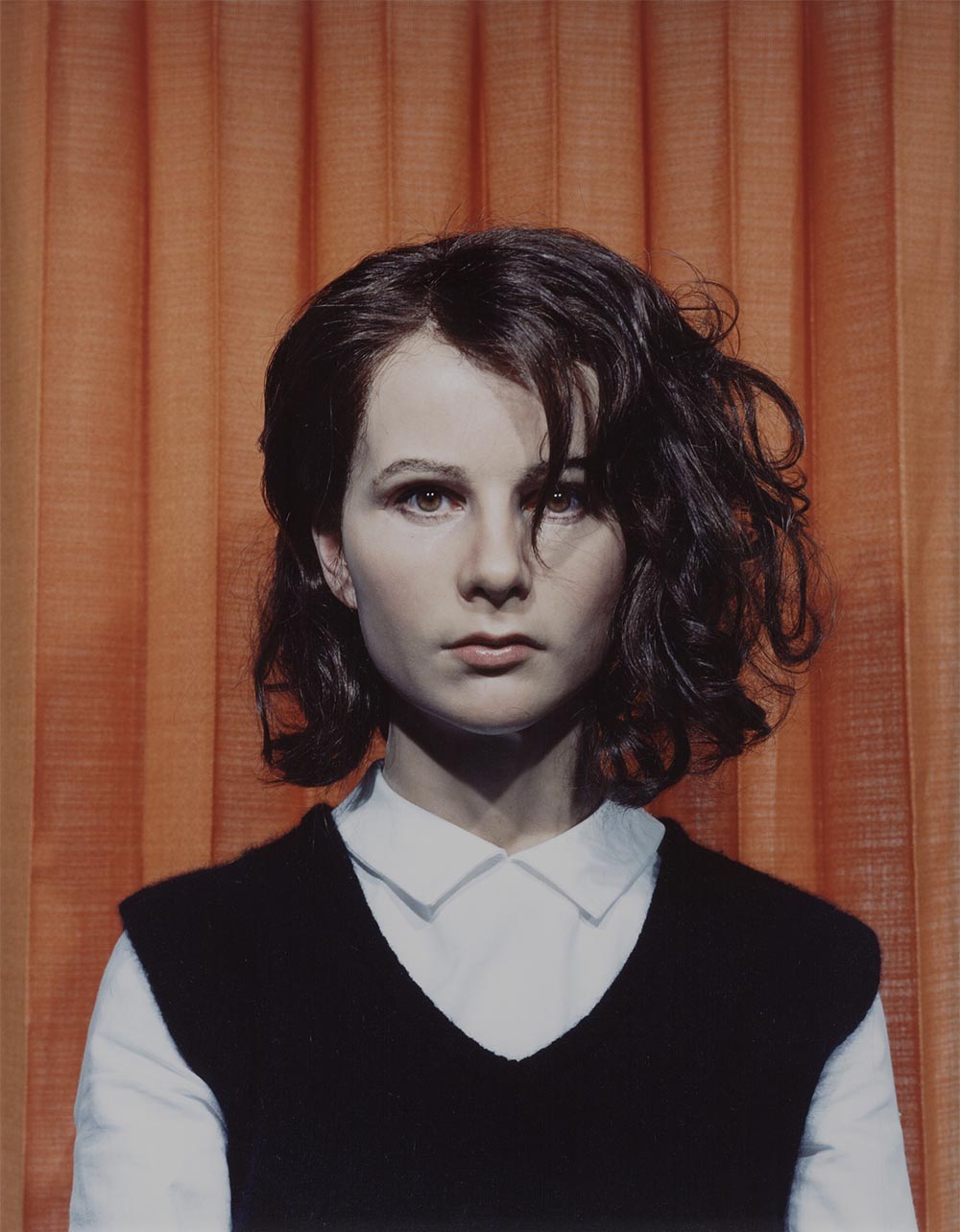
Self Portrait at 17 Years Old (2003), Gillian Wearing.
The artist reconstructs her teenage image and invites us to reflect on the relationship between who we once were, who we are today, and how we remember ourselves. [Photograph]. Retrieved from: https://www.moma.org/collection/works/89925
But family albums also contain absences. Events that were never photographed. People who barely appear. Encounters that were left outside the frame. Experiences that the family preferred to remember differently.
Photography, like any form of representation, involves selection. Our visual history is also a relational and cultural construction.
Family photographs show us part of our lives, but they also tell us about the people who looked at us and the stories they constructed about us.
Autobiographical memory has one fundamental characteristic: remembering an experience means reconstructing it from the present. The Spanish word recordar, meaning “to remember”, comes from re-cordis, suggesting a return through the heart.
Our memories preserve information about events we have experienced, but the way we retrieve them is influenced by our current knowledge, emotions, expectations, and the interpretations we have developed over time. This explains why the same experience can take on different meanings at different stages of our lives.
Imagine someone who moved to different cities several times during adolescence.
For years, they may remember those moves as a succession of farewells and losses. However, when revisiting their story later in life, they may discover that they also developed curiosity, flexibility, or a particular sensitivity towards people arriving in unfamiliar places. The events remain part of their biography, but the story they tell about them has changed.
Autobiographical memory therefore plays a role in shaping our identity.
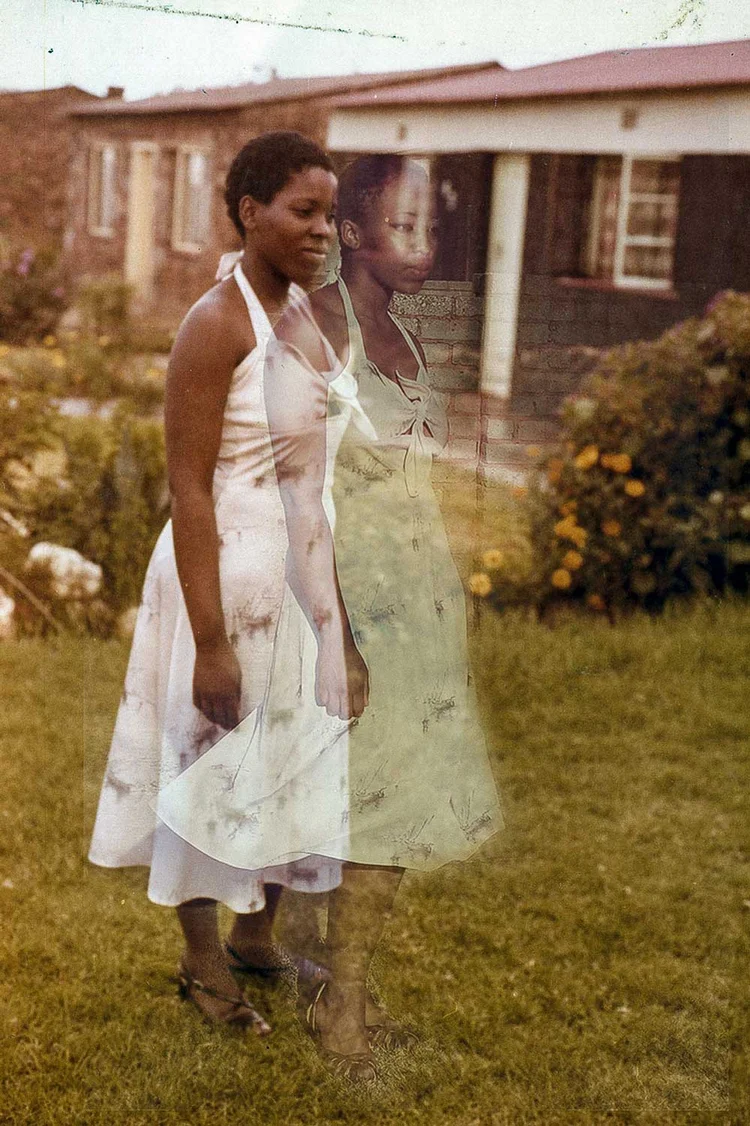
Ke Lefa Laka: Her-story (2013), Lebohang Kganye.
The artist places herself within photographs of her mother to explore family memory and how the stories of those who came before us contribute to the construction of our identity. [Photograph]. Retrieved from: https://www.lebohangkganye.co.za/ke-lefa-laka-herstory-2013-all
Psychologist Dan P. McAdams, one of the leading researchers in narrative identity, suggests that we construct life stories that bring together our reconstructed past, our present, and the future we imagine. These narratives allow us to establish connections between events, recognise continuities, and give meaning to the changes we have experienced.
Our personal story, therefore, is more than a chronology. It is an interpretation.
Imagine you have one minute to introduce yourself to someone. What would you say?
When we tell others who we are, we select events, establish connections between them, identify defining moments, and assign meaning to certain experiences. Some become central to our story. Others fade into the background.
Sometimes we discover connections that had previously gone unnoticed. At other times, an experience that once seemed to define us loses some of its prominence when we manage to see it as part of a broader story.
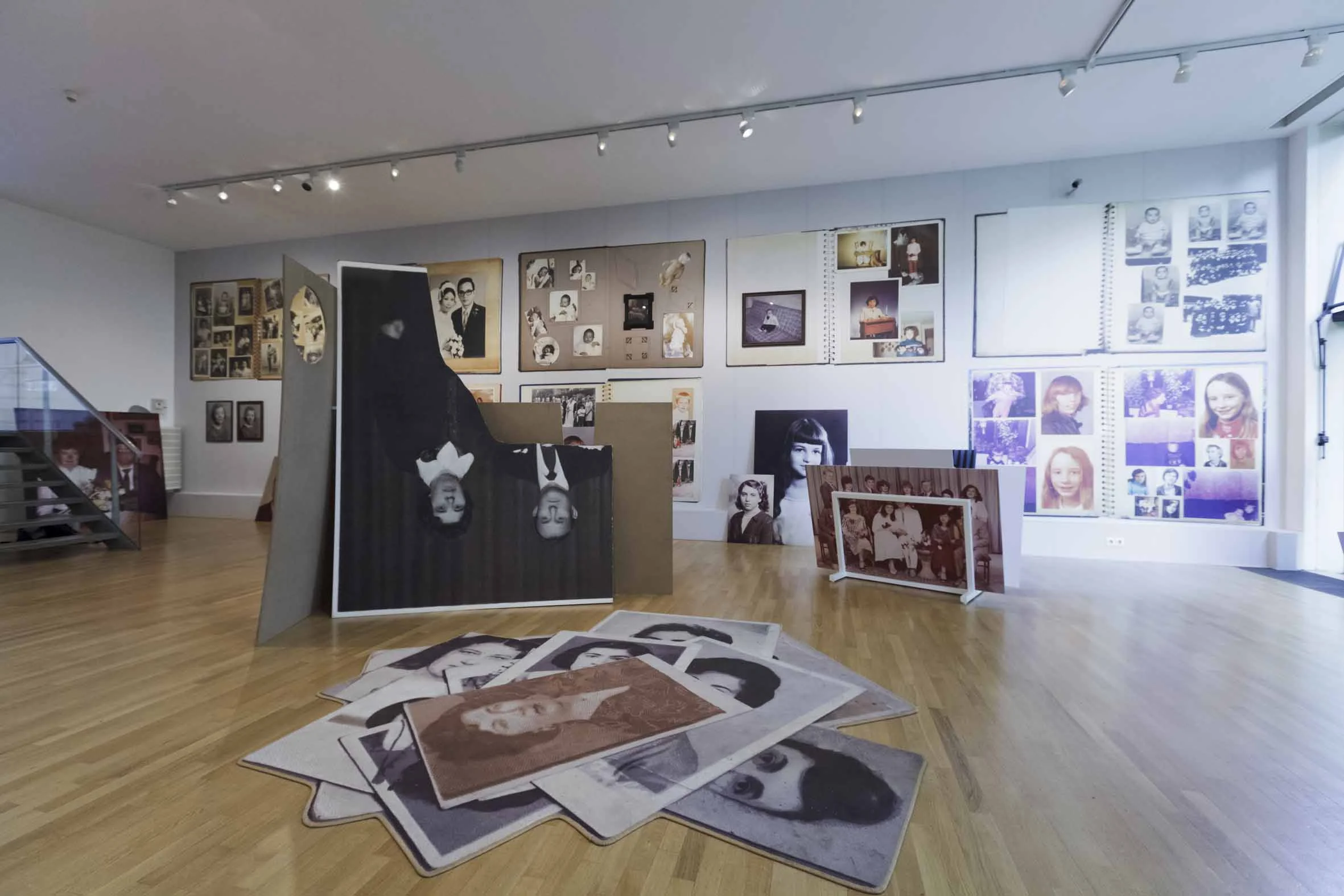
Album Beauty (2012), Erik Kessels.
An installation created from family photo albums that invites us to reflect on how we select, preserve, and organise the images through which we tell our life stories. [Photograph]. Retrieved from: https://www.erikkessels.com/album-beauty
Philosopher Paul Ricoeur developed the concept of narrative identity to explore how we can maintain a sense of personal continuity despite the changes we experience.
Narrative allows us to connect different stages of our existence without reducing them to a completely fixed identity.
Narrative psychology has explored how the stories we construct about our lives contribute to shaping our identity. Psychologist Michele L. Crossley argues that narrating our experiences allows us to organise them, establish connections between events, and develop meanings that contribute to our sense of personal continuity.
Along similar lines, psychologist Dan McAdams explains that our identity takes shape through life stories that connect the past we reconstruct, the present we experience, and the future we imagine.
From this perspective, telling our story is much more than remembering what happened. It is a way of interpreting our experiences and actively participating in the construction of who we are.
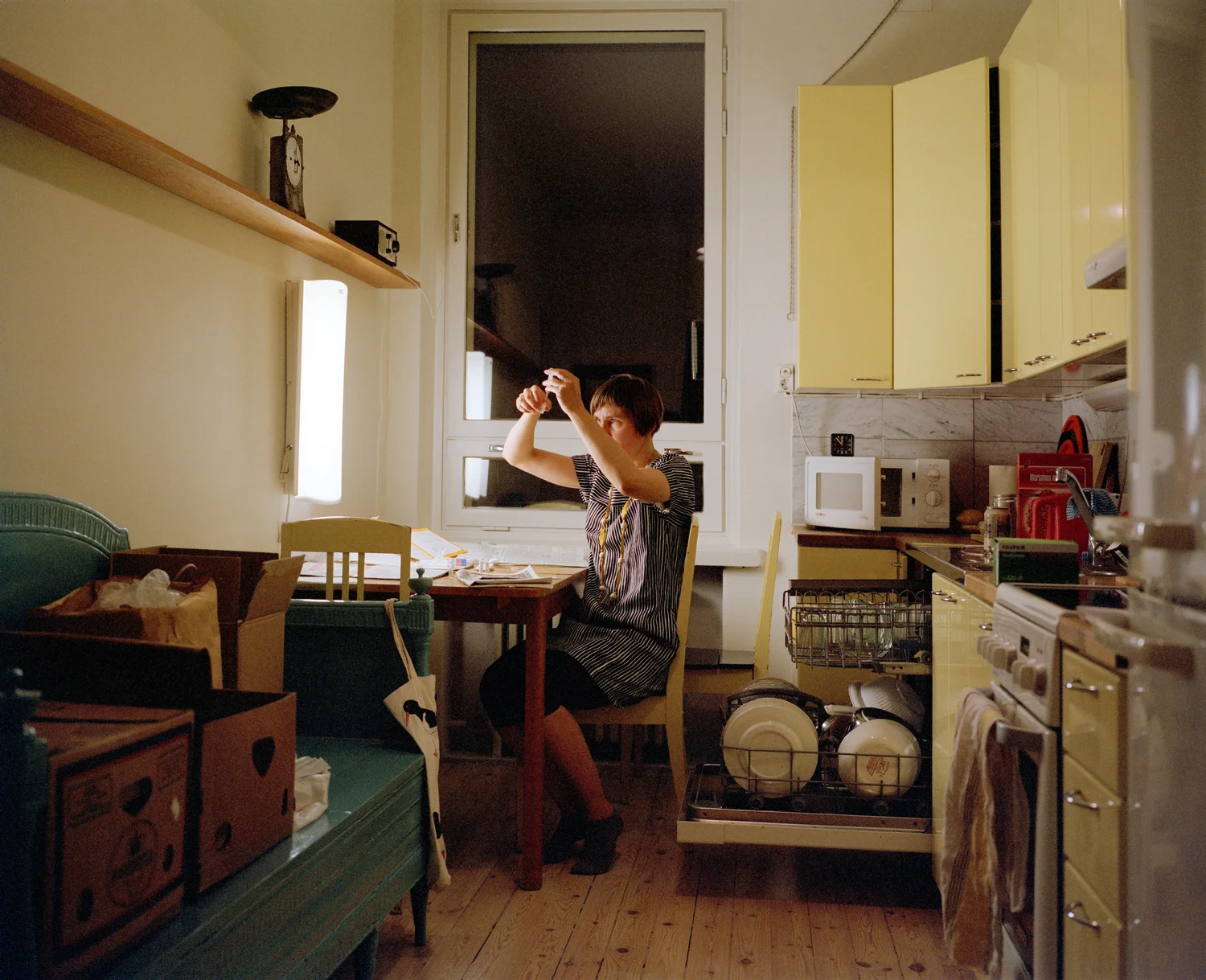
Annonciation (2009-2013), Elina Brotherus.
Through self-portraiture, the artist explores intimate experiences and significant life events, revealing how our personal history influences the way we understand ourselves. [Photograph]. Retrieved from: https://www.elinabrotherus.com/still#/annonciation/
From this perspective, writing an autobiography or revisiting the family photo album involves much more than describing events. It means actively participating in the interpretation of our own existence.
By telling our life story, we also construct a way of understanding who we are.
A photograph can trigger memories, emotions, associations, and questions. But its autobiographical meaning goes far beyond what it shows.
Imagine a photograph of a house where we lived as children.
To someone else, it may simply be a picture of a house. To us, it may hold memories of safety, fear, belonging, conflict, games, or farewells. It may even evoke contradictory experiences.
Perhaps for years that house represented the happiness of childhood. Later, when looking at the photograph, we begin to recognise the difficulties we were unable to understand at the time. Photography can become a starting point for exploring that complexity.
When we select images from our past, arrange them, establish connections between them, and construct a narrative, we engage in a process of autobiographical interpretation. We decide which events take centre stage, which connections we want to explore, and from which perspective we look at our life’s journey.
In this sense, photobiography can be understood as a process of narrative construction through images, memories, and words. Its value lies in the possibility of viewing our story from different perspectives, recognising meanings, and raising questions about our identity. It also lies in accepting that the same image can hold different stories.
In Pixar’s film Up, Carl discovers something extraordinary when he looks through Ellie’s photo album again: the life he believed was full of adventures left unfulfilled was actually filled with small moments that had, in themselves, been one great adventure. The photographs remain the same. What changes is the way he interprets their story.
What if some of our photographs also held stories we have yet to discover?
There is an important difference between looking at photographs that other people have taken of us and creating our own images.
In the first case, we explore representations that form part of our history.
In the second, we participate directly in constructing a representation of ourselves.
Self-portraiture offers a particularly interesting possibility: deciding how we want to see ourselves. We can explore aspects of our identity that usually remain hidden. We can represent emotions, contradictions, desires, or ways of being in the world that rarely appear in conventional photographs.
We can also question the images we have learned to reproduce. What happens if someone who has always portrayed themselves as strong decides to explore their vulnerability? Or if someone who has spent years playing a secondary role in family photographs decides to become the protagonist of their own images?
Self-portraiture allows us to experiment with different ways of representing ourselves. And this experimentation can open up new spaces for our identity.
Of course, creating a different image does not automatically transform how we perceive ourselves. Processes of self-knowledge are complex and depend on many factors. But photography can provide a space in which to observe, explore, and develop personal representations.
We often organise our biography around a limited number of events or characteristics. We define ourselves through what happened to us, certain relationships, the decisions we made, or what other people said about us.
These stories can help us understand our experiences. But they can also limit our understanding when they become the only explanations we accept.
The narrative perspective invites us to recognise that no personal story can be fully captured in a single description. A life contains countless events, relationships, emotions, and possibilities for interpretation.
Working with photographs can help us rediscover aspects of our lives that have been left out of the dominant narrative.
Perhaps we will find images that contradict the way we remember a particular stage of our lives. Perhaps we will discover moments of independence where we previously remembered only dependence, or meaningful relationships during periods we had defined entirely through loneliness.
The aim is to broaden our understanding of our experiences while respecting their complexity. And to recognise that we can revisit the interpretations we have constructed about ourselves.
Every photograph maintains a connection to a moment in the past, but our gaze belongs to the present.
Between the image and the person looking at it lie the years we have lived, the lessons we have learned, the losses we have experienced, the relationships we have formed, and the personal transformations we have undergone. That is why looking at our photographs again can become an opportunity to reconsider how we understand our own story.
Perhaps we will discover that some images represent us differently than they once did. That certain definitions we considered unchangeable allow for greater nuance. That the people we once were held more possibilities than we remembered.
Our identity is constructed through our relationships with others, but also through our ability to reflect on those relationships and develop our own narratives. Photography can accompany us on that journey.
Getting to know ourselves means learning to recognise the gazes that have shaped our self-image and discovering the perspective from which we want to continue looking.
Bruner, J. S. (1990). Acts of meaning. Harvard University Press.
Crossley, M. L. (2000). Introducing narrative psychology: Self, trauma and the construction of meaning. Open University Press.
Fivush, R. (2011). The development of autobiographical memory. Annual Review of Psychology, 62, 559–582. https://www.annualreviews.org/content/journals/10.1146/annurev.psych.121208.131702
Harper, D. (2002). Talking about pictures: A case for photo elicitation. Visual Studies, 17(1), 13–26. https://www.tandfonline.com/doi/abs/10.1080/14725860220137345
McAdams, D. P. (2001). The psychology of life stories. Review of General Psychology, 5(2), 100–122. https://journals.sagepub.com/doi/10.1037/1089-2680.5.2.100
Ricoeur, P. (1990). Soi-même comme un autre. Éditions du Seuil.
Cómo citar este artículo
Al citar, reconoces el trabajo original, evitas problemas de plagio y permites acceder a las fuentes originales para obtener más información o verificar datos. Asegúrate siempre de dar crédito y de citar de forma adecuada.
How to cite this article
By citing an article, you acknowledge the original work, avoid plagiarism issues, and allow access to the original sources for further information or data verification. Make sure to always give credit and cite appropriately.
Psychologist and teacher.With over two decades of expertise, Amparo studies and supports individuals who use photography to enhance their creativity and facilitate their personal growth. Through her work over the years, she has provided valuable information via articles, masterclasses, and courses covering topics that intersect photography and psychology and embarked on personal photography projects. In collaboration with Javier Sancho Boils, she has created ANDANAfoto. Since 2015, they have offered photography workshops with various organizations and platforms.She is the author of the books “Fotografía para crecer. Guía práctica para enseñar fotografía en la infancia y adolescencia (Photography to Grow: A Practical Guide for Teaching Photography to Children and Adolescents)” and “Descubre la fotografía. Mirar, crear y disfrutar desde la infancia (Discover Photography: Look, Enjoy, and Create from your Childhood)”.