More than ten years ago, we started ANDANA with an idea that remains at the heart of our project: using photography as a tool for self-knowledge.
Not everyone connects with photography in the same way. But for those of us who feel that an image can say much more than it shows, photography opens up a particularly interesting path to observe ourselves, ask ourselves questions, and better understand our own story.
Taking photographs involves making choices. We choose where to look, what to leave out, what to move closer to, what we want to preserve, and which moments, people, places, or objects capture our attention. And those choices can also tell us something about ourselves.
Where do we focus our attention?
Through our photographs, we can recognise our values, needs, emotions, experiences, relationships, and ways of seeing. We can discover what keeps recurring, pause to consider aspects of our lives that usually go unnoticed and, above all, become more aware of where we focus our attention and how we are living.
Because knowing ourselves also means increasing our capacity to choose: deciding, based on our own values, experiences, and needs, what we want to preserve and when we need to change direction. And choosing is also a way of moving closer to happiness.
Photography to Get to Know Yourself: More Than Ten Years Using Images for Self-Knowledge.
From this idea, Photography to Get to Know Yourself was born, a learning experience that we have continued to review, research, and enrich over the years.
Today, our methodology integrates photography, psychology, mindfulness, visual storytelling, contemporary art, and contributions from third-wave therapies.
It is not intended to teach you how to take technically better photographs. Instead, it invites you to use images to ask yourself questions:
What am I looking at? Why am I photographing this? What appears again and again in my photographs? What do my images say about what I value, fear, need, or desire? What story am I building, and what story do I want to build, about my own life?
The camera is no longer simply a tool for looking outward; it becomes a way of looking inward..
But does it really work?
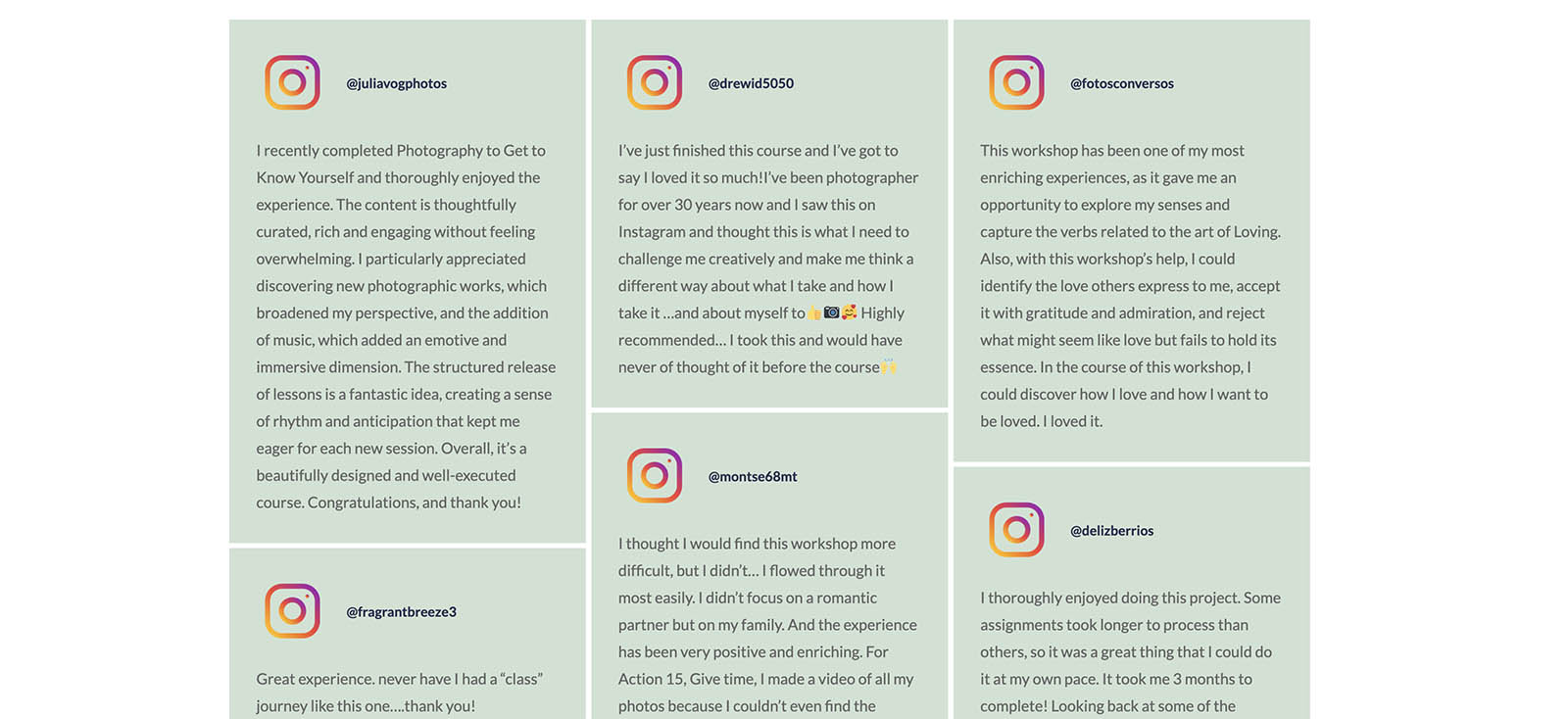
Over the years, we have received testimonials from people who, after completing the course, told us about their discoveries, changes, and personal transformations.
Receiving these stories is deeply moving. But as a psychology professional, there was a question I needed to ask myself: What lies beyond the testimonials and the kind words of gratitude? Can we measure some of these changes?
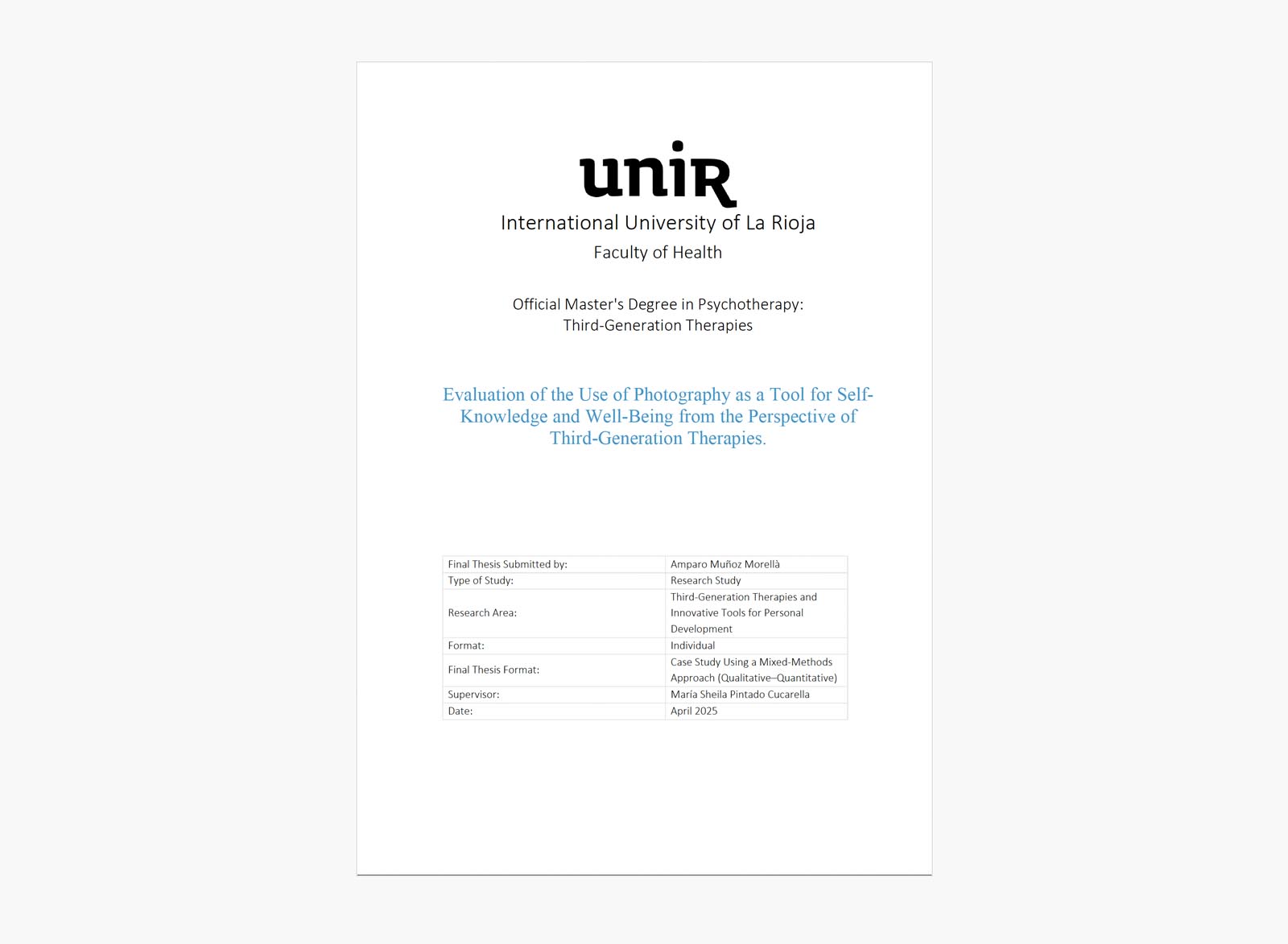
This question led us to devote a year to researching the impact of our methodology, using validated psychological instruments to assess different processes, including mindfulness, psychological flexibility, experiential avoidance, and self-esteem.
In addition to the quantitative measures, we conducted interviews to understand how participants had experienced the programme.
What did we find?
The results were particularly interesting.
We found statistically significant improvements in processes related to observing, the ability to describe internal experience, acting with awareness, psychological flexibility, and self-esteem. We also observed a reduction in experiential avoidance.
This is an initial study, with its limitations and many questions that still need to be investigated. It is not intended to close the debate, but rather to open it.
For us, it represents the beginning of putting data behind something we had been observing and hearing for many years.
And perhaps the most interesting thing is that we are talking about something as everyday and accessible as taking a photograph.
An image can become an opportunity to pause, observe, and better understand who we are and how we are living our lives.
Do I need to undergo a therapeutic process to use photography as a tool for self-knowledge?
No. And this distinction is fundamental.
Photography to Get to Know Yourself was created and continues to be a self-knowledge experience open to anyone who is curious about discovering themselves through their own images.
You do not need to be undergoing a therapeutic process, have a psychological problem, or receive professional support to take the course.
The methodology offers experiences and tools that allow you to observe yourself, ask yourself questions, and get to know yourself better in an autonomous, creative, and personal way.
But everything we have learned over these years, together with the results of our research, is now leading us towards clinical practice.
Photography and clinical psychology: can photography be used as part of a psychological intervention?
More and more psychology professionals tell us that they use photographs and images in their clinical practice, recommend our learning experiences, and find them to be a source of information and support.
And this takes us into different territory. A photograph can help us pause and reflect on an experience, observe it from another perspective, or find a way to talk about something that can sometimes be difficult to express through words alone.
Images can help us explore memories, emotions, relationships, identity, values, needs, or certain narratives about ourselves and our personal history.
But a self-knowledge experience and a psychological intervention are not the same thing.
The fact that an activity involving photographs is revealing, emotional, or transformative does not automatically mean that it is a therapeutic technique.
When we talk about photography and clinical psychology, we need to understand when it can be useful, for whom, with what therapeutic goals, and which psychological processes we intend to work on.
Towards a rigorous use of photography in clinical practice
We are working to study and structure more rigorously the clinical possibilities of photography as a complementary tool within psychological intervention.
Our aim is to move towards developing a manual for psychology professionals covering, among other areas, three main fields.
1. Clinical assessment and areas of application
Not every tool is suitable for every person or for every stage of a therapeutic process. It will be necessary to establish criteria that help determine when the use of photographs may be appropriate, which processes they can help explore, what the objectives are and, equally importantly, when not to use them.
2. Therapeutic intervention using photographs
We want to study and structure approaches that make it possible to work on specific psychological processes through photographs, self-portraits, autobiographical images, visual storytelling, and other photographic resources.
It is not simply about “taking photographs in therapy”. Each approach needs to have a clearly defined psychological purpose and be integrated within an assessment, a set of objectives, and a therapeutic process.
3. Monitoring and self-recording between sessions
Photography can also be valuable as a complement to certain tasks carried out between sessions. It can be incorporated, for example, into thought diaries, emotional or behavioural records, and other forms of self-monitoring that make it possible to observe experiences, situations, patterns, or changes and subsequently work on them in therapy sessions.
A photograph can record something that happened, but it can also help us reconnect with how we experienced what happened.
It is not about turning every photograph into therapy
We do not want to turn every photographic exercise into a therapeutic technique or attribute capabilities to photography that it does not have.
We want to research, organise, evaluate, and understand where photography can genuinely add value and where its limits lie.
Because a photograph can open a door. But within a professional psychological intervention, knowing why to open it, when to do so, what to do with what emerges, and how to support the person requires professional knowledge and skills.
That is precisely the territory we now want to continue exploring.
If you are a psychology professional, we want to hear from you
We know that some professionals are already using photographs in their clinical practice.
If you are a psychology professional and use images in your sessions, are experimenting with them, or are interested in incorporating them in the future, we would like to hear about your experience and introduce you to our methodology.
And if you simply want to get to know yourself better…
All this research does not change what ANDANA was founded on.
You do not need to be a psychologist or be undergoing a therapeutic process to discover the possibilities that photography can offer you.
If you enjoy taking photographs and are curious to understand why you look at the world the way you do, what your images say about you, or what you can discover through them, you can begin your own journey of self-knowledge.
Photography to Get to Know Yourself is a methodology for using your own photographs as a doorway to your memories, emotions, values, needs, and ways of seeing.
Because photographs show us who we are and what we have lived through, but they can also help us discover who we want to be and the direction we want our lives to take.
ONLINE SPECIALIZATION COURSE ON SELF-KNOWLEDGE THROUGH PHOTOGRAPHY
This course includes all the necessary tools to learn about and experience photography as a tool for personal transformation, theories, practical content, inspiration, and 26 activities.
Photography to Get to Know Yourself is a pioneering, scientifically validated program that uses photography as a tool for personal reflection, creativity, and human development. It has been developed over more than ten years and enriched by the experience of thousands of participants from different countries.
Al citar, reconoces el trabajo original, evitas problemas de plagio y permites acceder a las fuentes originales para obtener más información o verificar datos. Asegúrate siempre de dar crédito y de citar de forma adecuada.
How to cite this article
By citing an article, you acknowledge the original work, avoid plagiarism issues, and allow access to the original sources for further information or data verification. Make sure to always give credit and cite appropriately.
Psicóloga, divulgadora y docente. Cuenta con más de 20 años de experiencia en la intervención comunitaria y la integración social. Investiga y acompaña a personas que apuestan por la fotografía como estrategia para potenciar su creatividad y como herramienta de crecimiento personal, desarrolla una importante labor divulgativa a través de artículos, masterclass y cursos en materias como la fotografía y la psicología o el acompañamiento de proyectos fotográficos personales. Autora de los libros "Fotografía para crecer. Guía práctica para enseñar fotografía en la infancia y adolescencia", "Descubre la fotografía. Mirar, crear y disfrutar desde la infancia" y "Eres aquello que miras" de la colección Fotografía para conocerte.