Photography now occupies a central place in our daily lives. We constantly create images: we document moments, relationships, emotions, spaces and experiences with our mobile phones almost automatically. However, although we live surrounded by photographs, we rarely stop to reflect on the psychological meaning of the images we create or on the way they can help us better understand ourselves.
For years, different branches of psychology and expressive therapies have been exploring the therapeutic potential of images. Photography has begun to be used in contexts related to trauma, self-esteem, identity, grief, social inclusion and emotional regulation, showing promising results in processes of personal development and psychological well-being.
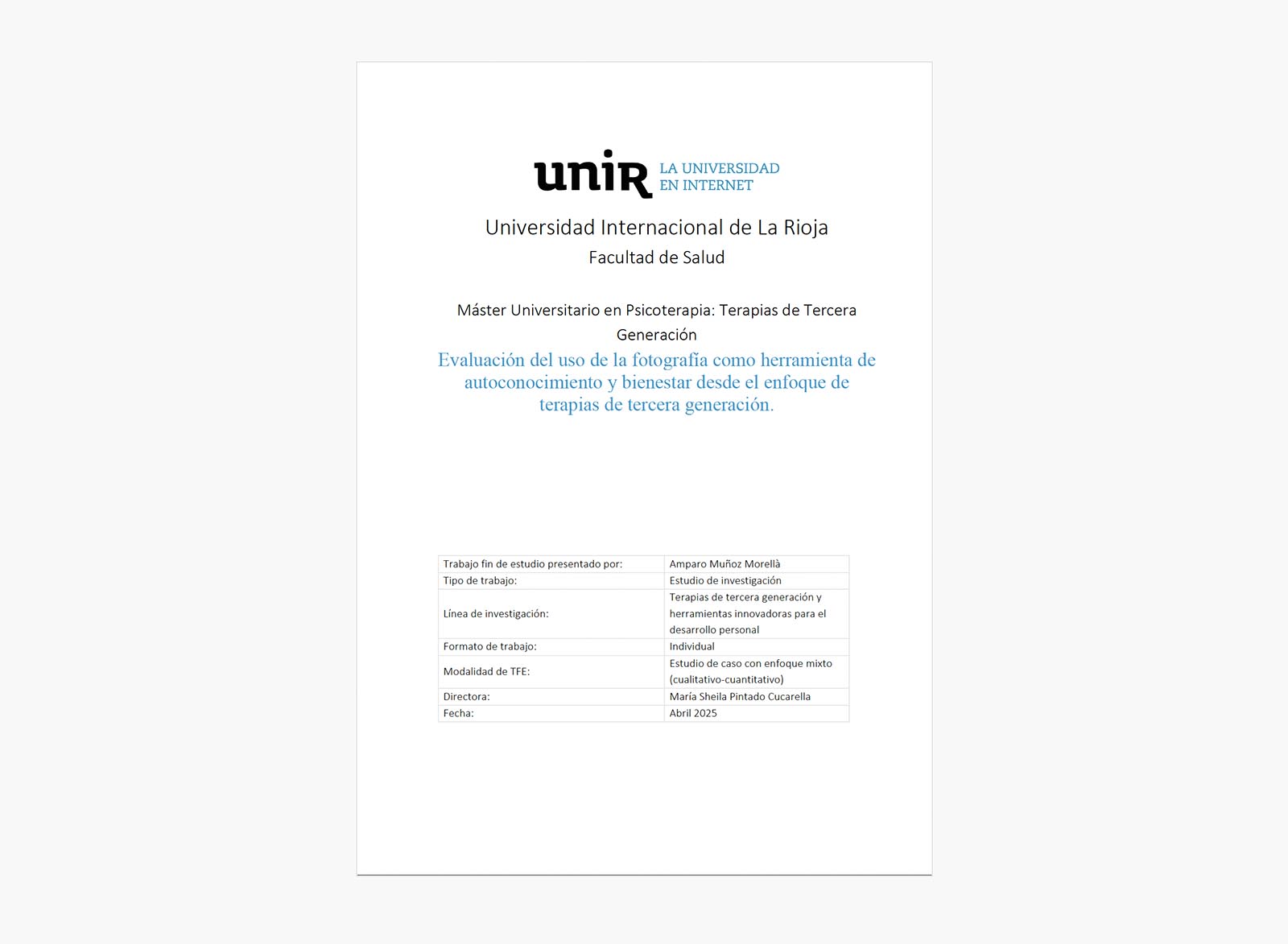
In this context, the International University of La Rioja (UNIR) has recently published my Master’s Thesis in its academic repository
Evaluation of the Use of Photography as a Tool for Self-Knowledge and Well-Being from the Perspective of Third-Wave Therapies.
This research analyses the impact of the “Photography to Get to Know Yourself” Programme, a 24-session online training course that integrates photography, mindfulness and Acceptance and Commitment Therapy (ACT) within the framework of third-wave therapies.
The main objective of the study was to evaluate to what extent the conscious use of photography can contribute to self-knowledge, mindfulness, psychological flexibility and self-esteem.
Photography as a Psychological Tool
Photography possesses characteristics that are especially relevant from a psychological perspective: images facilitate access to autobiographical memories, activate emotional processes and allow aspects of inner experience to be represented that are often difficult to express verbally.
Various authors have pointed out that the image functions not only as a visual record, but also as a symbolic construction of experience. Photographing involves selecting, interpreting and giving meaning. In this sense, photographs can offer relevant information about the way a person perceives the world, organises their experience and constructs their identit.
The research reviewed within the theoretical framework of the study shows that working with images can promote:
- emotional expression
- the narrative processing of life experiences
- the reconstruction of identity
- emotional regulation
- body awareness
- autobiographical reflection
- interpersonal connection
In addition, various contemporary approaches have begun to integrate photography into therapeutic and educational models based on aesthetic and symbolic experience.
Photography, Mindfulness and Third-Wave Therapies
One of the central aspects of this research is the relationship between photography, mindfulness and contextual therapies such as Acceptance and Commitment Therapy (ACT).
Third-wave therapies have represented an important shift within contemporary psychology. Unlike models focused exclusively on symptom elimination, these approaches place emphasis on processes such as:
emotional acceptance
psychological flexibility
mindfulness
values clarification
the relationship with thoughts
commitment to meaningful actions
From this perspective, photography can be understood as an experiential tool capable of facilitating several of these psychological processes.
For example, the practice of contemplative photography encourages attention to the present moment and reduces the tendency to function on “autopilot”. Self-portraiture and visual narrative make it possible to explore identity and self-image from a kind and flexible perspective. Likewise, symbolic work with images facilitates the observation of thoughts, emotions and difficult experiences from a certain psychological distance, something closely related to the processes of cognitive defusion described in ACT.
So-called mindful photography or conscious photography has attracted growing interest in recent years. Different studies suggest that the act of photographing from an attentive and non-judgemental attitude can promote emotional regulation, reduce mental rumination and increase connection with present experience.
What Does the “Photography to Get to Know Yourself” Programme Consist Of?
The programme analysed in this research is “Photography to Get to Know Yourself”, an online workshop for self-knowledge through photography. It was designed as an experiential training course structured into 24 thematic sessions.
Each session combines:
- psychological content
- introspective photography exercises
- visual narrative
- mindfulness practices
- artistic and cultural references
- personal reflection exercises
The training is not focused on the technical learning of photography. Its main objective is to use the image as a tool for observation and psychological exploration.
Throughout the programme, aspects related to the following are explored:
- self-esteem
- identity
- the relationship with the body
- emotional acceptance
- autobiographical memory
- fears
- social masks
- values clarification
- personal narrative
- mindfulness
Some activities involve creating symbolic self-portraits; others focus on contemplative photography, family memory, the visual representation of emotions or the creation of narrative sequences about one’s own life.
The aim is for the person to develop a more conscious gaze towards themselves and their emotional experience through the images they create and observe, fostering real transformation.

Sandra Carolina Montoya Salazar, Photography to Get to Know Yourself Gallery – @caro_montoya_arteneagramatica – Colombia
Research Methodology
The research used a mixed methodology, combining quantitative and qualitative tools.
To evaluate the psychological impact of the intervention, three instruments widely validated in clinical and health settings were used:
- Five Facet Mindfulness Questionnaire (FFMQ)
- Acceptance and Action Questionnaire-II (AAQ-II)
- Rosenberg Self-Esteem Scale (RSES)
In addition, follow-up open interviews were conducted to gather the subjective experience of the participants.
The aim was to analyse both the measurable psychological changes and the personal experience of the process.
Main Results
The results obtained show statistically significant improvements especially in:
- conscious observation skills
- emotional description
- mindfulness
- conscious action
- the reduction of experiential avoidance
- psychological flexibility
- self-esteem
One of the most relevant findings was the increase in the ability to consciously observe and describe inner experience, as well as the reduction of emotional avoidance patterns, becoming aware and daring to discover oneself.
On a qualitative level, many participants described the experience as a process of reconnecting with themselves. Several pointed out that working with images allowed them to identify emotions, personal patterns and aspects of their identity that until then had remained outside conscious awareness.
Frequent references also emerged to:
- a greater capacity for introspection
- a less critical relationship with one’s own image
- a more compassionate perception of personal history
- an improvement in emotional awareness
- a sense of presence and connection with the present moment
Although this is an exploratory study and has the limitations inherent to a pre-experimental design, the results provide relevant evidence regarding the potential of photography as a complementary tool within the field of psychological well-being and personal development.
Beyond Aesthetics: Photography as an Experience of Awareness
One of the most interesting aspects emerging from this research is the need to rethink the place photography occupies today.
In a culture marked by the overproduction of images and constant exposure, photography is often associated with visual performance, aesthetics or social validation. However, this work proposes a different perspective: understanding photography as a practice of observation, awareness and psychological reflection.
When the image is used from an introspective perspective, it ceases to be merely a visual result and becomes an experiential process.
The question is no longer “How do I take a good photograph?” but instead becomes:
- What am I looking at?
- What interests me about this image?
- What emotions arise?
- What aspects are repeated in my photographs?
- What story am I constructing about my life?
This shift in perspective opens especially interesting possibilities for professionals in psychology, education, social intervention, art therapy and mental health. It is also an easy and accessible tool for anyone who wishes to explore themselves.
An Invitation to Continue Researching and Exploring
The publication of this research represents an important step within a still emerging field: the use of photography as a psychological tool based on processes of mindfulness, psychological flexibility and personal narrative.
We already knew it, we already suspected it, we already sensed it. However, it is also important to remember that scientific evidence is not a definitive endpoint.
Scientific evidence is not a final verdict, but a continuous, collective and ever-evolving process. Its strength lies in its ability to self-correct, recognise its limitations and improve over time.
In a world saturated with data, opinions and pseudo-certainties, understanding its dynamic nature is essential. Scientific evidence does not close debates: it opens them. More than an answer, it is a permanent invitation to continue asking questions.
Today, I can affirm that the work ANDANA has developed over the years through the “Photography to Get to Know Yourself” Programme is supported by academic and scientific evidence.
Photography does not only document experiences.
It can also help us understand them.
And perhaps, in certain contexts, it can also help us transform them.
If you are a professional in psychology, mental health, education or the social field, if you love photography and personal development, I invite you to discover this training, share it and explore the possibilities photography offers as a tool for intervention, reflection and personal development.
Virginia Satir used to say that we can only love what we truly know. Now we also know that learning to look at our images can be a way of beginning the beautiful path of self-knowledge, and perhaps of learning to love ourselves.
I am sharing the link here in case you are interested in exploring the full research:
UNIR Repository – Evaluation of the Use of Photography as a Tool for Self-Knowledge and Well-Being
Cómo citar este artículo
Al citar, reconoces el trabajo original, evitas problemas de plagio y permites acceder a las fuentes originales para obtener más información o verificar datos. Asegúrate siempre de dar crédito y de citar de forma adecuada.
How to cite this article
By citing an article, you acknowledge the original work, avoid plagiarism issues, and allow access to the original sources for further information or data verification. Make sure to always give credit and cite appropriately.
Amparo Muñoz Morellà. (May 15, 2026). "Photography as a Psychological Tool Based on Scientific Evidence". ANDANAfoto.com. | https://andanafoto.com/en/photography-as-a-psychological-tool-based-on-scientific-evidence/.