Photography and Clinical Psychology: From Self-Knowledge to Professional Practice

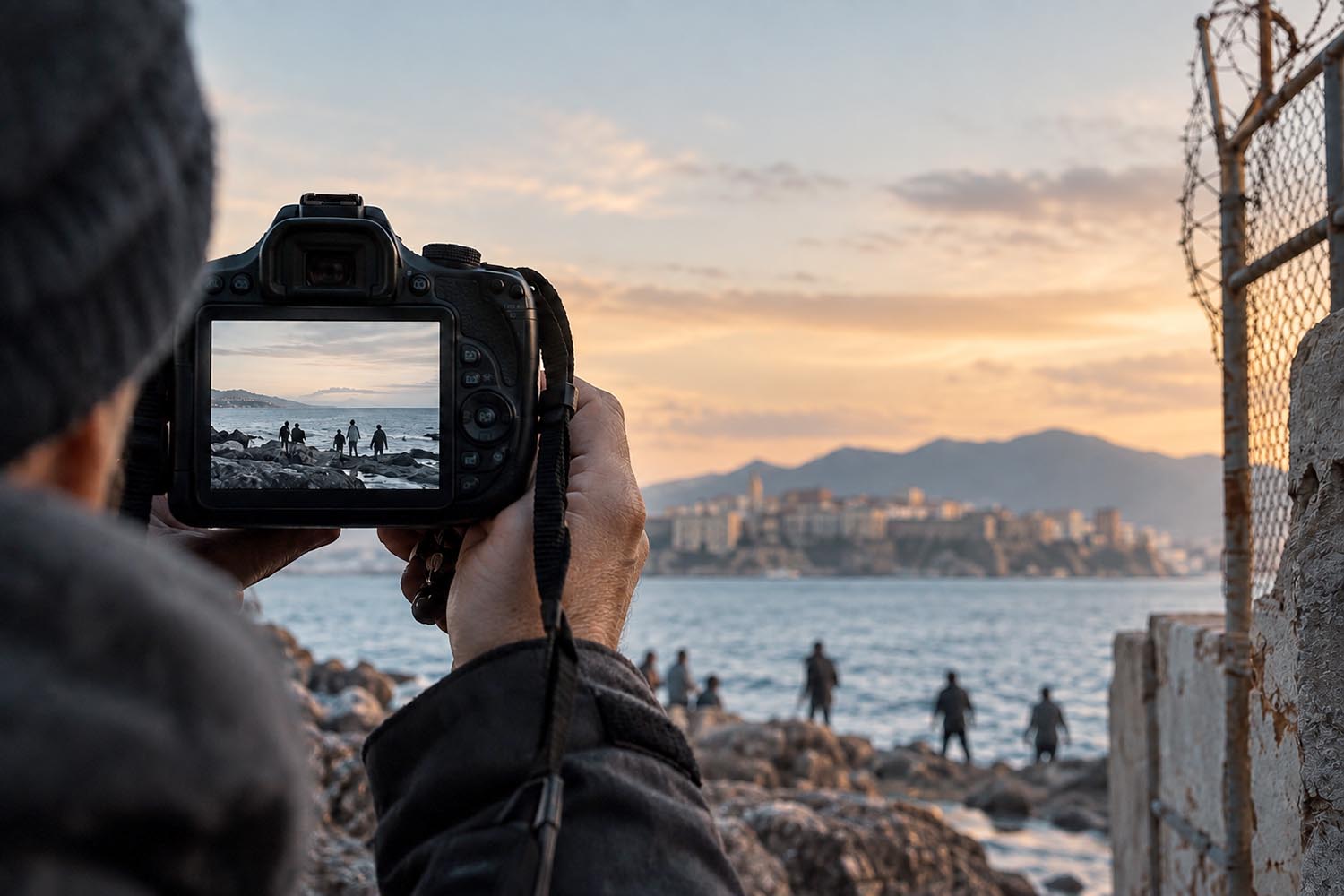
We are used to thinking that a photograph shows something that was already there. That the camera records an event and that the more faithfully the image reflects what happened, the more objective its representation will be.
But photography is not simply about recording.
Before an image reaches our eyes, many things have already happened: someone has decided where to position themselves, what to include in the frame, what to leave out, from what distance to look, when to press the shutter and which image to select afterwards. And once published, that photograph enters a particular context: it appears alongside a headline, words, other images and a particular way of telling what happened.
This is why a photograph can be truthful and, at the same time, not be neutral.
Every image offers a situated perspective. It allows us to see something, while at the same time leaving other things outside our field of vision. It can bring us closer to a reality or turn it into a category. It can restore a person’s individuality or visually transform them into part of a group. It can make an experience visible or contribute to certain ways of looking becoming the only ones we recognise as possible.
The question, therefore, is not only what a photograph shows, but also from where that gaze has been constructed, what power relations shape it and what imaginaries are produced through its repetition.
This question becomes especially relevant when we photograph realities shaped by social inequalities, borders, migration, poverty, exclusion or conflict. In these contexts, seemingly formal decisions —distance, angle, framing, selection or repetition— can also have consequences for the way certain people are perceived and understood.
Photography does not merely document reality. It also participates in constructing what we understand as reality.
And if every gaze is situated, then certain questions arise:
Who is looking?
From where are they looking?
Who is allowed to be looked at?
And who has the possibility of constructing their own representation?
To explore these questions, we can focus on a specific case: the way in which the arrival of migrants in Ceuta has been represented through photography.
At the end of July 2026, an extraordinarily large number of migrants entered Ceuta. The photographic coverage showed, among other things, large groups arriving by sea, people running across the beaches, soldiers and police officers forming barriers, people being escorted towards the border and rescues in the water. A month later, RTVE reported more than 50,000 arrivals and more than 5,000 people who remained in the city.
An aerial photograph, or one taken from an elevated position, showing hundreds or thousands of people moving towards a border can be documentarily truthful. What it shows happened. But its factual truth does not exhaust its meaning.
Framing, distance, repetition and selection can transform individual people into a mass.
Before continuing, pause for a moment. Look at some of the photographs through which what happened in Ceuta has been visually narrated. Then come back here and ask yourself a question: from where are we looking?
You can see here the photographs and RTVE’s photographic coverage of the arrivals in Ceuta in July 2026.
What kind of imaginary do we construct when we repeatedly represent a reality in a particular way?
Names, biographies, reasons for migrating and family relationships disappear; practically every trace of individuality disappears.
What remains visually is a crowd moving towards “us”. And this is where the political dimension of the image emerges.
This question about the position from which we look is not new. It has been explored across different fields of thought and is particularly compelling in Donna Haraway’s work on situated knowledges.
Donna Haraway, an American scholar, specifically challenges the fantasy of a gaze capable of observing the world from nowhere, as though the person looking had no body, position, history or interests.
In her 1988 essay, she argues that all knowledge is shaped by the specific social, physical and historical context of the person observing it.
She uses the concept of the “god trick” (the “God trick”) to critique traditional scientific objectivity as the illusion of seeing everything from nowhere. She considers it a disembodied point of view that claims universal truth while concealing its own position of power. In contrast, she proposes situated knowledges: every gaze comes from a particular position, and our vision is limited and located. Acknowledging our specific position allows us to construct more honest, responsible and precise claims.
Knowledge is produced by real, physical bodies in specific places.
Every photograph is a situated gaze.
The person taking the photograph never looks “from nowhere”: they look from a body, a history,
a social position, a territory and a particular relationship with what they photograph.
The camera never looks from nowhere. It is above or below, close or far away, on this side of the border or the other, alongside the police or alongside those crossing, with a telephoto lens or a 50mm lens…
And each of these positions produces a different visual reality.
That is why we can choose one of those general images of Ceuta and say: This photograph may be truthful. But it is not a neutral gaze.
The question is not only what we see. The question is where we are looking from and who makes and shares the image.
For John Berger, looking is never an innocent act. This question is one of the central themes of Ways of Seeing. His work challenges the apparent naturalness of images and invites us to investigate the ideologies and social relations embedded in forms of representation.
Images are not harmless. They do not simply show the world. They also participate in constructing the categories through which we later think about the world.
When we see a person swimming exhausted towards a beach, we have a particular experience.
When we see thousands of people from above, the perceptual experience changes. We see volume, movement, border, control; it is no longer an individual, but a crowd.
What happens when the accumulation of certain images ends up visually constructing migration as a mass moving forward, a wave arriving, a border being overwhelmed?
Here, even verbal and visual language can reinforce one another. In the coverage, we find expressions such as “mass arrival”, “overwhelmed” or groups being escorted towards the border.
The imaginary can be constructed through accumulation.
The frame conditions which lives we come to recognise
Judith Butler
For Judith Butler (2009), the frames through which we see and represent the world are never neutral: they organise our perception and condition which lives appear recognisable, valuable and worthy of mourning.
Because the frame does two things simultaneously: it shows and excludes.
When we photograph hundreds of migrants entering Ceuta, we show something real: the scale of the event.
But that same framing can leave out:
To frame is to decide what enters the image and what remains outside it. Every frame is therefore a selection of reality and a positioning on the part of the person taking the photograph.
The possibility of the people being photographed participating in the production of the images shifts the question from representation towards participation.
We would probably still see Ceuta. But perhaps we would stop seeing only “migration”.
We do not know what they would photograph. And that is precisely what matters.
We should not assume that they would photograph suffering, borders or injustice. Perhaps they would photograph the sea. A pair of shoes drying. Food. A friend. A video call with their mother. The place where they sleep. Something they find beautiful. Something that frightens them. Something absurd. Something we would never consider relevant to the news.
And that would not be anecdotal; it would be knowledge. Because it would allow us to discover what they consider worthy of being looked at.
When Caroline C. Wang and Mary Ann Burris developed Photovoice, one of the fundamental ideas was precisely to enable people whose voices are rarely heard to record and reflect on their communities from their own point of view, generate collective dialogue and bring that knowledge to decision-makers.
So, what happens to our knowledge of migration when migrants also produce the images through which we try to understand it?
Who has the ability to produce knowledge about a reality?
Ariella Aïsha Azoulay takes this question even further. In The Civil Contract of Photography, she proposes that we stop thinking of photography solely as an image produced by a photographer and instead consider it as an event in which relationships are established between the person taking the photograph, the person being photographed and the person looking at it.
The person being photographed then ceases to be simply raw material for someone else’s narrative. The question is no longer only what this photograph represents, but what power relations make this representation possible and what position each person occupies within it.
From this perspective, photography can reproduce an unequal relationship, but it can also become a space in which to discuss, question and transform it.
In this way, we can develop our capacity for «civic imagination»: a way of seeing and imagining ourselves as part of the image, rather than merely as spectators.
This shifts the focus from the product —the photograph— to the practice and the relationships that constitute the photographic event. Images can reinforce an oppressive reality, but they can also resist it.
What place does a person occupy in the construction of their own representation?
Who participates in the construction of what is visible?
Perhaps the question is not to find a single image capable of representing a complex reality on its own. Perhaps the question is to ask ourselves how many different gazes we need before we can begin to understand it.
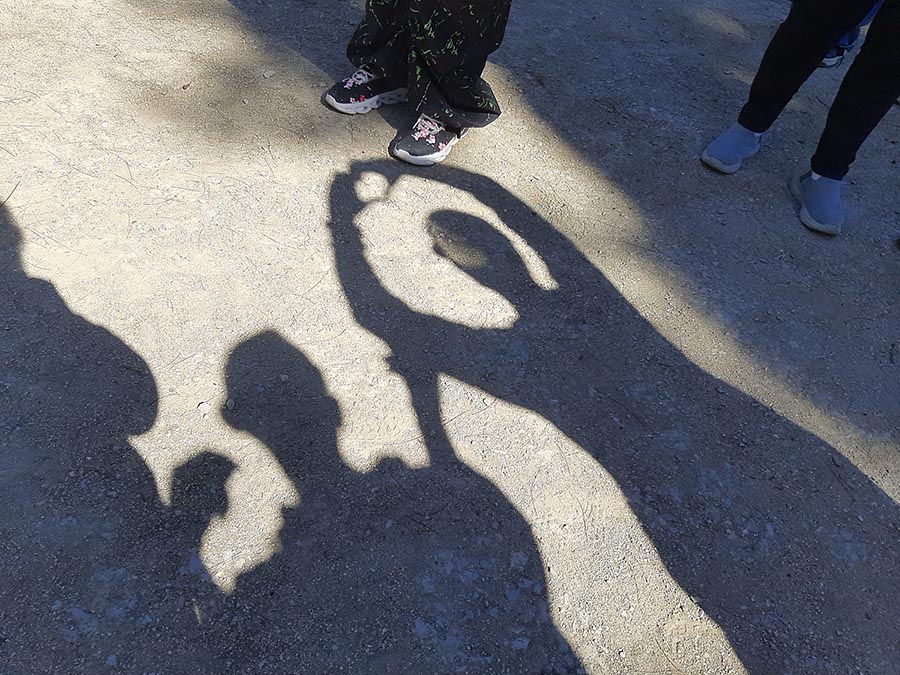
Photograph by Raúl Prado – ThruLens – Through the Lens: capturing inclusion
A photograph will always be partial. So too will the gaze of the person taking it, the person who appears in the image and the person looking at it. There is no single perspective that can fully encompass a human experience.
That is why giving someone the camera does not mean replacing one representation with another supposedly more truthful or more authentic one. It means opening up the possibility for questions, experiences and ways of looking to emerge that were not previously part of what we considered visible.
Perhaps a person who has migrated would photograph the sea. Or a room. A conversation. A meal. Someone they love. Something they find beautiful. Something they find strange. Perhaps they would photograph something that has no apparent connection to migration at all.
And that is precisely where the value lies.
Because when we stop deciding in advance what a person should photograph, we also stop deciding for them which aspects of their experience deserve to be known.
Photography can then cease to be merely a tool for representing others and become a practice for constructing knowledge with others.
It is not about finding a definitive gaze. It is about making space for more ways of seeing.
Because perhaps the true power of photography lies not only in deciding what we show, but in asking ourselves:
Who has the possibility of deciding what deserves to be seen?
Azoulay, A. A. (2008). The civil contract of photography. Zone Books.
Azoulay, A. A. (2012). Civil imagination: A political ontology of photography. Verso.
Berger, J. (2000). Ways of Seeing. Editorial Gustavo Gili.
Butler, J. (2009). Frames of war: When is life grievable? Verso.
Fernández-Pacheco Sáez, J. L., Rasskin-Gutman, I., Marques, E., & Yoshihama, M. (2022). (Digital) PhotoVoice and its role in community development and the construction of collective identity: Towards critical and participatory citizenship through education. Research in Education and Learning Innovation Archives, 28, 77–93. https://doi.org/10.7203/realia.28.21795
Haraway, D. (1988). Situated knowledges: The science question in feminism and the privilege of partial perspective. Feminist Studies, 14(3), 575–599.
Wang, C., & Burris, M. A. (1997). Photovoice: Concept, methodology, and use for participatory needs assessment. Health Education & Behavior, 24(3), 369–387. https://doi.org/10.1177/109019819702400309
Cómo citar este artículo How to cite this article
Al citar, reconoces el trabajo original, evitas problemas de plagio y permites acceder a las fuentes originales para obtener más información o verificar datos. Asegúrate siempre de dar crédito y de citar de forma adecuada.
By citing an article, you acknowledge the original work, avoid plagiarism issues, and allow access to the original sources for further information or data verification. Make sure to always give credit and cite appropriately.
Amparo Muñoz Morellà. (September 30, 2026). "Where Are We Looking From? Photography, Power and Representation". ANDANAfoto.com. | https://andanafoto.com/en/where-are-we-looking-from-photography-power-and-representation/.
Psychologist and teacher.With over two decades of expertise, Amparo studies and supports individuals who use photography to enhance their creativity and facilitate their personal growth. Through her work over the years, she has provided valuable information via articles, masterclasses, and courses covering topics that intersect photography and psychology and embarked on personal photography projects. In collaboration with Javier Sancho Boils, she has created ANDANAfoto. Since 2015, they have offered photography workshops with various organizations and platforms.She is the author of the books “Fotografía para crecer. Guía práctica para enseñar fotografía en la infancia y adolescencia (Photography to Grow: A Practical Guide for Teaching Photography to Children and Adolescents)” and “Descubre la fotografía. Mirar, crear y disfrutar desde la infancia (Discover Photography: Look, Enjoy, and Create from your Childhood)”.