Where Are We Looking From? Photography, Power and Representation

There are gatherings you arrive at with so much to share and return from with even more questions, unfinished conversations and endless dialogues.
From October 1 to 3, we were in Gijón taking part in EIFA 2026, the Asturias International Photojournalism Conference. A meeting place for professionals working in photography, journalism, film and human rights, with a programme of workshops, exhibitions and conversations about images and the ways we represent the world.
For Javier and me, it was a particularly moving experience. It gave us the opportunity to share the work we do at ANDANA and our experience in participatory photography, but also to listen to professionals with extraordinary careers and explore other ways of understanding the responsibility that comes with creating images.
I took part in two activities: the Photojournalism Workshop: Looking, Editing, Telling Stories and the roundtable discussion Humanistic Photojournalism alongside Ricardo García Vilanova (a freelance photographer specialising in conflict zones and humanitarian crises), Anna Surinyach (a photojournalist specialising in refugees and displaced people), Olmo Calvo (a photojournalist specialising in documenting the crisis in Spain), moderated by Álex Zapico (a Spanish photojournalist and documentary photographer and EIFA coordinator).
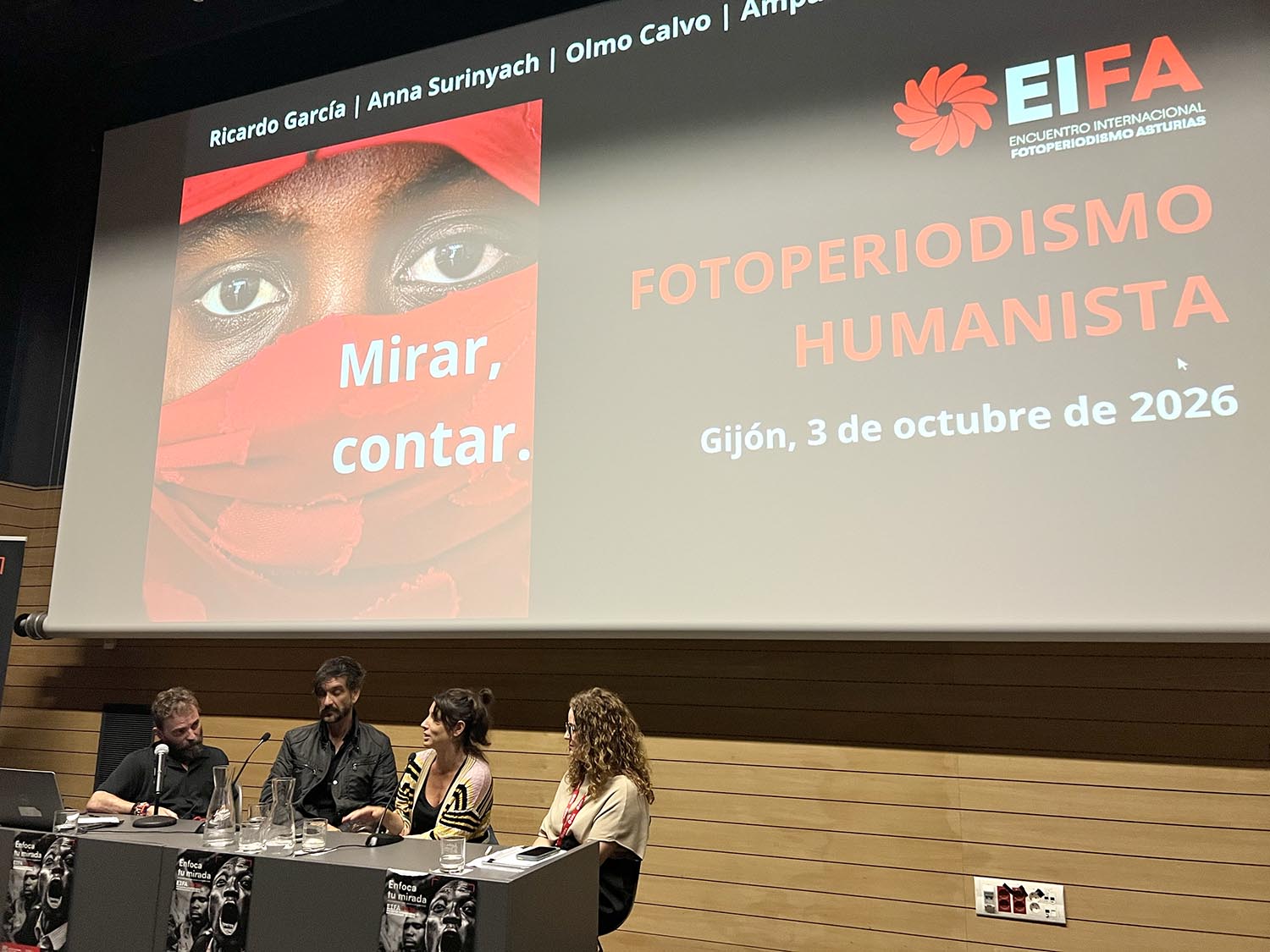
Although they had different formats and audiences, both shared a question that runs through much of our work: What happens when a group of people is able to express themselves through images?
In the workshop Looking, Editing, Telling Stories, I shared some of the ideas we have been exploring for years through psychology and participatory photography.
We often think that the photographic act begins when we press the shutter button. However, many things have already happened long before that moment. We have decided where to direct our attention, what interests us, the position from which we observe and what we consider important to show.
Photography is never a complete reproduction of reality.
It is a selection that inevitably says something about the person who is looking.
That is why this selection is connected to our experiences, our culture, our knowledge, our expectations and our way of understanding the world.
Donna Haraway points out that every gaze comes from somewhere. Recognising the position from which we observe does not mean giving up on understanding reality, but rather gaining a better understanding of the conditions under which we construct that knowledge.
There is a long tradition of humanistic photography, which has made an enormous contribution to recognising people’s dignity and experiences.
What changes when the people being photographed also participate in creating the images and the stories?
Participatory photography invites us to broaden the relationship between the photographer and the person being photographed. People can have a say in what is photographed, how the images are interpreted, the decisions about which images are selected and shared and, most importantly, the purpose of the project.
We explored methodologies such as Photovoice, photo elicitation and photographic walks, recognising that each can open up different possibilities for expression, dialogue and the collective construction of knowledge.
We also shared experiences developed by ANDANA and other organisations, including projects related to inclusion, community memory and social participation.
One of the central ideas was that participatory photography does not seek to replace the photographer’s gaze, but to incorporate other perspectives that can enrich it.
It is not about giving up authorship, but about asking ourselves which decisions we can share and what knowledge emerges when different experiences come together.
On Saturday, I took part in the roundtable discussion Humanistic Photojournalism, alongside Ricardo García Vilanova, Anna Surinyach and Olmo Calvo, moderated by Alex Zapico.
Contributing to this conversation from my experience as a psychologist was particularly interesting. I have spent 25 years working in social intervention and community action, and one of the fundamental lessons of humanistic psychology is that a person is always much more than what we can observe about them. And, of course, much more than what we can photograph.
In psychology, Carl Rogers taught us to understand the importance of relationships and proposed three fundamental conditions: empathy, unconditional positive regard and congruence or authenticity.
Empathy invites us to try to understand an experience from the other person’s frame of reference. Unconditional positive regard reminds us that their worth does not depend on their circumstances or behaviour. And congruence requires us to recognise our own presence within the relationship. When applied to photography, these ideas raise questions such as How do we relate to the people we photograph? What do we really know about them? What aspects of their experiences remain unknown to us?
A person may be a refugee, a migrant, have a disability or be going through a situation of extreme vulnerability. But none of these categories encompasses their entire life.
A person can need help and help others. Feel afraid and act courageously. Experience a terrible situation while still holding on to their sense of humour, their relationships, their desires and their plans for the future.
A photograph can tell a truth about someone without containing the whole truth of who that person is.
And this brings us to another issue we discussed: the role of images in shaping our collective imaginaries.
Photographs do not circulate in isolation. They encounter other images, previous narratives and the ideas that a society has developed about certain groups or realities. When the same category of people is repeatedly represented in a particular way, that representation can eventually come to seem like the only possible one.
That is why it is also important to ask ourselves which images are missing and which aspects of people’s lives are usually left out of our stories.
Another question that arose during the conference was whether photojournalists are also activists, where the boundary lies between documenting a reality and becoming involved in it, and how to maintain professional rigour without abandoning one’s own values.
But we also talked about what rarely appears in photographs: the personal sacrifices made by those who take them. Long periods away from home, risks, exposure to suffering and the difficulties of balancing this profession with family life. From a psychological perspective, we can speak about the need to recognise the person behind the camera too, their emotions, their relationships and their need for care.
From my experience in community action, there is one fundamental idea: knowledge does not belong to any one person.
Photographers bring their experience, their visual language, their judgement and their ability to construct narratives. But the people being photographed possess knowledge about their own lives and contexts that we can hardly access through observation alone.
When these different forms of knowledge come together, new questions, interpretations and possibilities can emerge. This is one of the foundations of participatory photography and methodologies such as Photovoice, developed by Caroline Wang and Mary Ann Burris and influenced by the thinking of Paulo Freire.
Freire advocated a process of knowledge construction based on dialogue and people’s active participation. Photovoice uses photographs and the conversations they generate to identify experiences, reflect collectively and, when the project allows, develop proposals for change.
What matters is not simply handing someone a camera. What matters is not receiving large numbers of images of an event, even if they were created by the people who were there. That is not participatory photography.
Participatory photography recognises people’s ability to produce knowledge, interpret their own reality and participate in the decisions that shape the narratives constructed about it.
That is why, during our participation in EIFA, we wanted to highlight one idea:
Sharing our gaze does not mean that we all have to see the same thing. It means discovering what emerges when different perspectives can come together.
In contrast to the harshness of many of the realities documented by photojournalism, we shared another dimension of our work at ANDANA: our methodology incorporates participatory photography through joy, play, creativity and human connection.
Working with people and communities means recognising their difficulties, but also their strengths, their desires, their humour and their ability to enjoy themselves and build things together. Sometimes, a photographic experience that begins with a fun activity ends up generating conversations, unexpected connections and new ways of understanding ourselves and one another.
Joy is not the opposite of social commitment; it is a powerful tool for participation and transformation.
One of the reflections I would like to take away from these days is that humanistic photojournalism and participatory photography are not opposing approaches.
Photojournalism plays an essential role in documenting events, bearing witness to realities and constructing narratives that help us understand the world.
Participatory photography can offer other tools for incorporating people’s experiences, broadening interpretations and exploring new ways of constructing knowledge.
Sharing decisions does not mean giving up authorship. It means recognising that our gaze, however valuable it may be, will always be partial.
And that sometimes, encountering other people can transform not only what we photograph, but also the way we understand it.
Perhaps a deeply humanistic photograph is not simply one that manages to portray someone with dignity. Perhaps it is also about allowing ourselves to be transformed by the person we are looking at.
Here we share the video of our participation in the roundtable discussion, where you can explore these reflections and the conversations that emerged around humanistic photography, representation and the collective construction of narratives.
Here you can watch the recording of the entire day’s programme. Saturday 3 Live: Humanistic Photojournalism and Film. Asturias International Photojournalism Conference.
We would like to end by thanking Alex Zapico, Luigi Carinci and the entire EIFA organising team for the invitation, their thoughtfulness and the enormous kindness with which they welcomed us during these days.
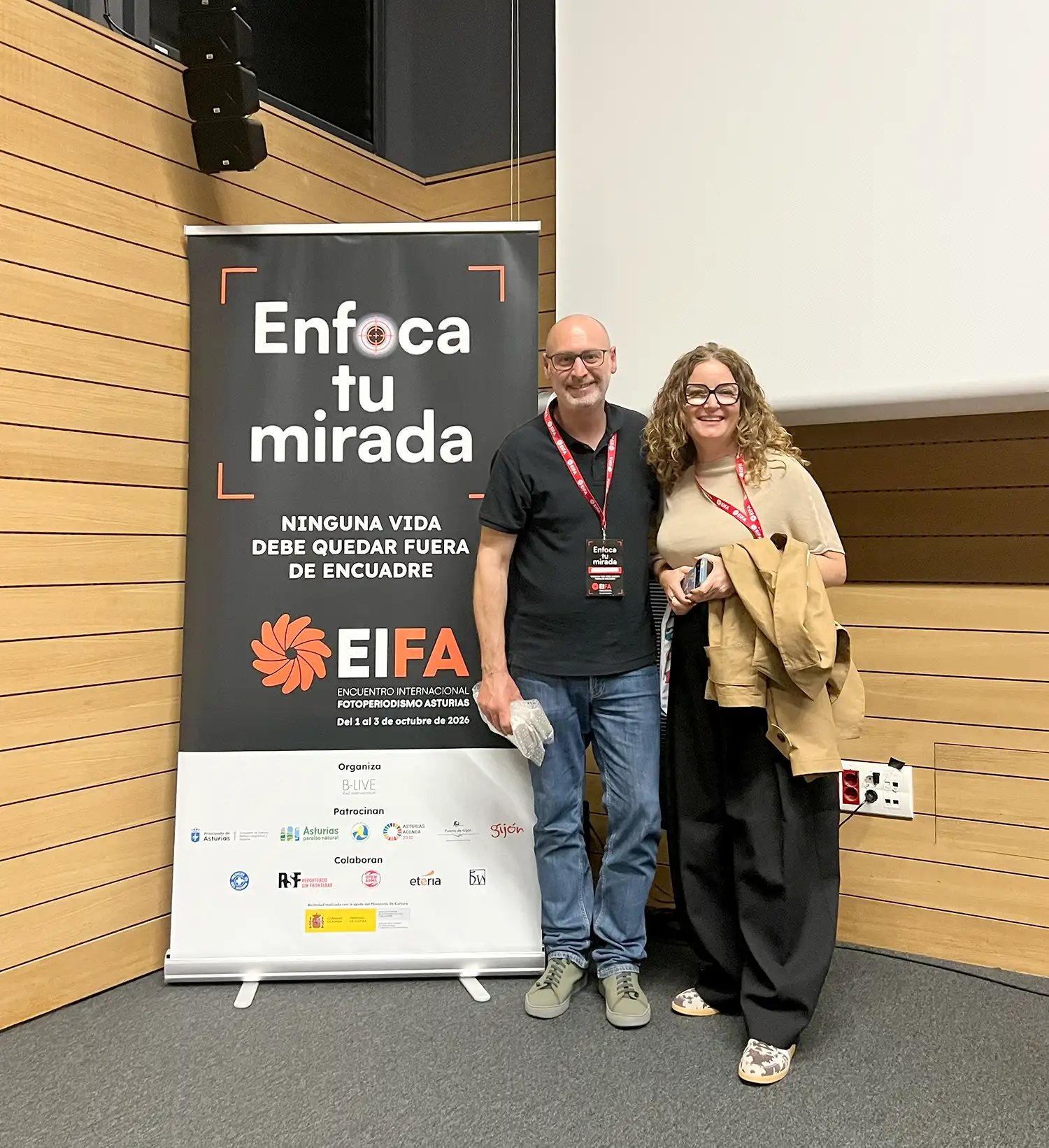
It has been a real pleasure to take part in such an interesting, thoughtfully organised and necessary gathering, to share conversations with professionals we admire and to enjoy an extraordinary programme of activities and exhibitions.
We returned from Gijón with new ideas, questions, insights and, above all, the joy of having met people who share our deep belief in the possibilities of photography.
Thank you for also making room for psychology and participatory photography within this conversation.
Cómo citar este artículo How to cite this article
Al citar, reconoces el trabajo original, evitas problemas de plagio y permites acceder a las fuentes originales para obtener más información o verificar datos. Asegúrate siempre de dar crédito y de citar de forma adecuada.
By citing an article, you acknowledge the original work, avoid plagiarism issues, and allow access to the original sources for further information or data verification. Make sure to always give credit and cite appropriately.
Amparo Muñoz Morellà. (October 13, 2026). "Humanistic Photojournalism, Psychology and Participatory Photography at the Asturias International Photojournalism Conference.". ANDANAfoto.com. | https://andanafoto.com/en/humanistic-photojournalism-psychology-and-participatory-photography-at-the-asturias-international-photojournalism-conference/.
Psychologist and teacher.With over two decades of expertise, Amparo studies and supports individuals who use photography to enhance their creativity and facilitate their personal growth. Through her work over the years, she has provided valuable information via articles, masterclasses, and courses covering topics that intersect photography and psychology and embarked on personal photography projects. In collaboration with Javier Sancho Boils, she has created ANDANAfoto. Since 2015, they have offered photography workshops with various organizations and platforms.She is the author of the books “Fotografía para crecer. Guía práctica para enseñar fotografía en la infancia y adolescencia (Photography to Grow: A Practical Guide for Teaching Photography to Children and Adolescents)” and “Descubre la fotografía. Mirar, crear y disfrutar desde la infancia (Discover Photography: Look, Enjoy, and Create from your Childhood)”.