Photography and self-knowledge
Have you ever thought about how you are? Who are you? If you are where you want to be? Typically, we don’t reflect on how we are, what makes us happy or brightens our days, unless something breaks our stability.

Have you ever thought about how you are? Who are you? If you are where you want to be? Typically, we don’t reflect on how we are, what makes us happy or brightens our days, unless something breaks our stability.
The evocative power of images has been widely studied. Through them, forgotten memories and stories, which are part of both individual and collective memory, can be verbalized and even reclaimed from oblivion. In this sense, the photographic image is an effective tool for promoting historical discourse and preserving personal memory.
Want to start a photography project but don’t know where to start?
Would you like to build and develop your photography project authentically?
Many people spend their lives not doing what they truly wish, believing they must follow what they are expected to do rather than what they truly want.
As a method or instrument of artistic expression, photography holds all the necessary characteristics to make us more cognitively and creatively effective.
It was a great find. Few books speak so clearly about the processes of therapeutic photography and the use of photography in personal spaces and social intervention.
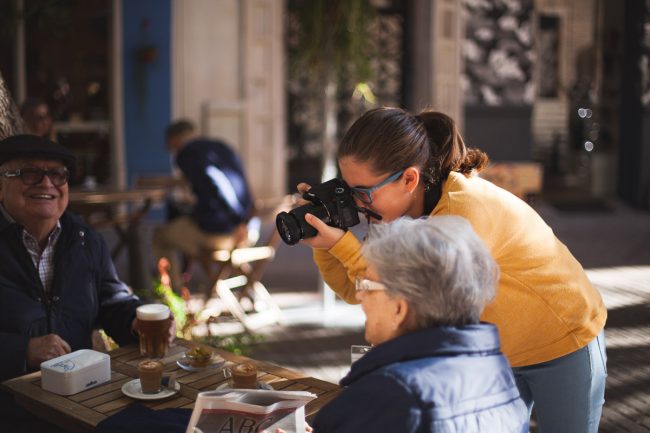
Photographic expression is a communicative process between the photographer and the viewer, but it is also a language between the person who takes the photograph and what is being observed.
Perception is the cognitive process through which we receive information and form an image of reality. When we perceive a photograph, we go through two phases: reception and interpretation.
A photograph is where the interests and desires of the viewer intersect, and these are just as important for the person taking the photo as they are for the viewer. Sometimes, the message aligns, and sometimes, it does not. That is why photography, rich in meaning for both the photographer and the viewer, is always an OPPORTUNITY.
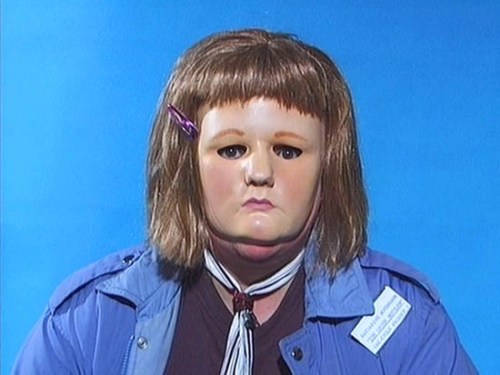
If your worst fear took a human form, what would it look like? Working with fear through photography is a creative task.
Visual education should be incorporated and emphasized from the beginning in all schools. It should be included alongside the study of literature, history, or mathematics. In language studies, we learn grammar first. In photography, we must learn visual grammar.