


In a world increasingly exposed to natural disasters, the images that hold our intimate memories —family photo albums— become vulnerable, along with much of our personal and collective history.
It is within this context that ONAF — Other Narratives of the Family Album — emerges, an international conference organized by the Universitat Politècnica de València, dedicated to interdisciplinary reflection on the preservation, restoration, and restitution of family photographs affected by natural disasters.
Held on November 20 and 21, 2025, exactly one year after the DANA that severely impacted several municipalities in Valencia, ONAF aims to create a space for dialogue and collaboration among professionals in conservation, restoration, memory studies, visual arts, archiving, anthropology, and anyone interested in the links between image, identity, and catastrophe.
Within this framework, the participation of Amparo Muñoz Morellà —psychologist and Andana collaborator— was not only the presentation of a personal testimony, but also the articulation of a proposal: to consider the family album as an emotional refuge, a tool for symbolic reconstruction, and an agent of community resilience.
Through her presentation, she showed how the work of recovering, restoring, or recreating photographs can support identities, reassemble fragmented memories, and offer individuals a starting point from which to rebuild themselves.
This blog post gathers the reflections that emerged from that presentation: a thoughtful look at the power of images to sustain life when what we believe to be safe collapses, and an invitation to value the family photo album as essential emotional heritage—both individually and collectively.
The starting point of the presentation was a specific, deeply human scene that many people in Catarroja still carry in their bodies: the hours following the DANA storm. It’s not easy to describe what it feels like to walk through a familiar place and no longer recognize it. The water had receded, but the mud still covered everything. Furniture was out of place, familiar smells had vanished, and the house —that space of safety— had become a room that spoke of loss.
Amid all that chaos, a photograph. Soaked, stained, almost unrecognizable, yet still alive enough to awaken something essential: continuity. That small image, rescued from the mud, brought back the certainty that life had existed before the catastrophe. That there was a story before —and that somehow, it could still hold on.
From that scene, the reflection opened up into an essential question: why are family albums so emotionally powerful? What sustains a photograph when everything else seems to fall apart?
Autobiographical memory: an emotional system, not a file archive
The answer lies not only in nostalgia, but in the very way human memory works. Neuropsychologist Martin Conway, one of the leading experts in autobiographical memory, explains that remembering our own life involves activating three elements: time, space, and personal experience. Autobiographical memory is what allows us to say, “I was the one who lived that,” and it is deeply emotional.
When we remember something, we are not retrieving a fact, but a state of being. That’s why certain photographs can awaken an entire constellation of sensations, smells, bonds, or moments that seemed forgotten.
Researcher Roberto Cabeza showed through neuroimaging that looking at a personal photograph activates brain areas related to the self and emotion, very different from those triggered by neutral images. In other words: family photographs don’t just show what happened, but who we were when it happened.
Psychoanalyst Donald Winnicott added another key idea when he spoke of “transitional objects”—those that help us maintain emotional continuity in times of change or loss. A blanket, a toy, a scent… or a family album. These are objects we don’t just remember —they sustain us.
Through them, we can return to an inner place where we feel seen.
When life falls apart, images help rebuild it
After a catastrophe, our personal narrative becomes fragmented. The brain switches into survival mode, leaving gaps in memory. Events become jumbled, intense sensations mix, and what happened seems distant or inaccessible.
At that moment, a recovered photograph —even if damaged— can become a key piece in reorganizing what was lived.
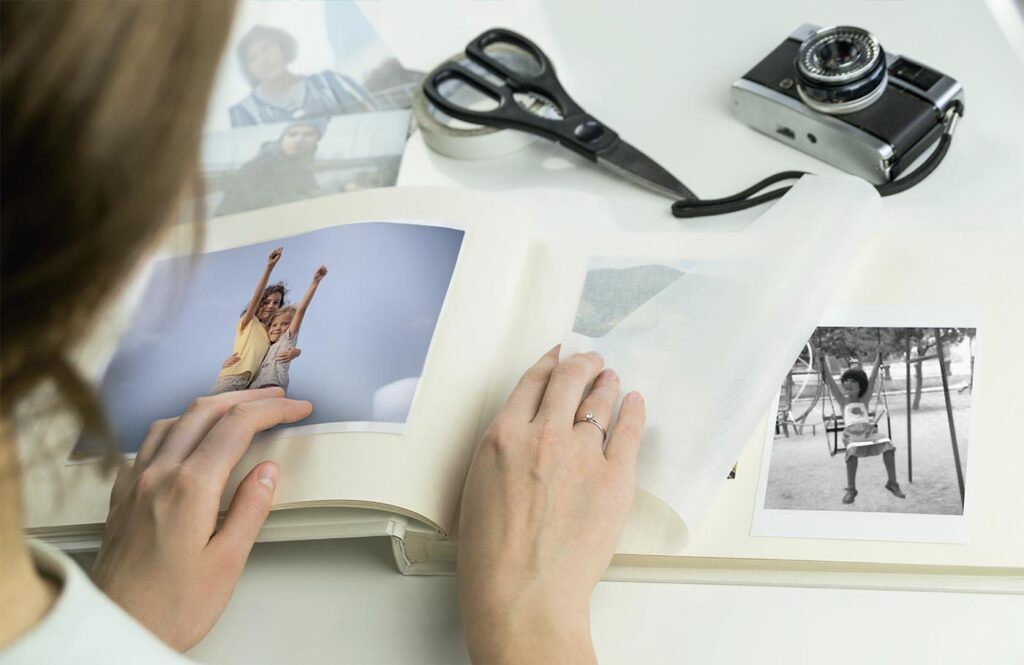
Images act as bridges between past and present; they help recall abilities, important bonds, and values that remain even when the physical surroundings have collapsed. The family album is not an archive: it is an emotional architecture where the continuity of one’s life rests.
Losing it, as Amparo shared in her talk, causes a deep and silent pain. What is lost is not just an object —it’s a part of one’s life story.
Re-generem l’àlbum familiar: a community looking at itself to rebuild
From this understanding also came the meaning behind the project Re-generem l’àlbum familiar, an initiative launched by the association Imatge i Acció after the DANA storm, with Amparo also taking part. The goal wasn’t just to restore or recover damaged photographs; it was to give the neighborhood back a space to see and recognize itself.
During the event, photos were printed, portraits were taken, stories were shared, losses were heard, and small acts of restoration were celebrated. The Les Barraques neighborhood, so deeply affected by the flooding, was transformed into a place where photography became a gesture of community care. Each photo taken or recovered was a reminder that they were still there, still a community.
That day, many people shared how posing again, holding an image, or simply seeing themselves in a current photograph gave them a sense of stability. These were simple gestures, but deeply therapeutic: looking at the person next to you, saying through a photo “we’re still here,” bringing light to where there had been mud.
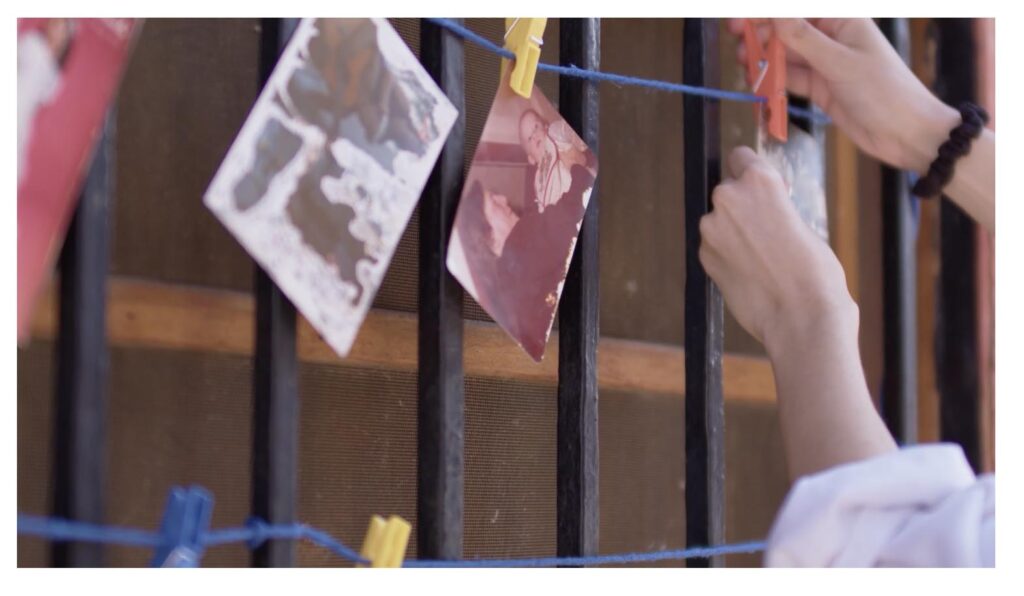
The entire RE-GENEREM l’àlbum familiar project.
Symbolic Repair: When Photography Becomes a Form of Healing
The presentation also included personal experiences and the creation of visual inventories of rescued objects and items to be discarded. These gestures echo Sol LeWitt’s Autobiography project, in which he photographed everything in his studio before moving out—creating, in this way, a wordless autobiography.
Such examples illustrate what Amparo emphasized during her talk at ONAF: when a life story is broken, the act of photographing can become a way to piece it back together. Photography doesn’t only preserve—it also repairs.
An Album Is a Place to Return To
The importance of the family album lies not only in its ability to represent the past, but in its power to connect the present with the future. Recovering an image can restore meaning, but creating a new one can also open a narrative where there was once a void.
That’s why family photographs are refuges: because they allow us to inhabit memory without getting trapped in it.
The work presented at ONAF served as a reminder that images sustain, accompany, and restore identity. That in difficult times, an album—whether restored, recreated, or reinvented—can become an act of courage and care, both individually and collectively. And that photography, when used with sensitivity and purpose, is a profound tool for rebuilding what cannot always be expressed in words.
From a technical and methodological perspective, the intervention presented at ONAF highlights the need to incorporate the family album as a tool for assessment, support, and narrative reconstruction in crisis contexts. The neuropsychological evidence from Conway, the neuroimaging studies by Cabeza, and Winnicott’s theoretical framework all provide scientific backing for the use of photography as a therapeutic device, offering empirical support for its ability to activate autobiographical memory, modulate emotional responses, and facilitate processes of psychic integration after trauma.
In this sense, projects like Re-generem l’àlbum familiar, driven by Imatge i Acció, exemplify how photography can become a structured psychosocial intervention—one capable of promoting community resilience, strengthening identity, and creating safe spaces for storytelling and meaning-making. The experience shared at ONAF not only validates these practices but also points to a clear path for continued research and the application of image-based methodologies as a fundamental part of emotional recovery and the reconstruction of social fabric.
References
Cabeza, R. (2008). Role of parietal regions in episodic memory retrieval: The dual attentional processes hypothesis. Neuropsychologia, 46(7), 1813–1827. https://doi.org/10.1016/j.neuropsychologia.2008.03.019
Cabeza, R., Prince, S. E., Daselaar, S. M., Greenberg, D. L., Budde, M., Dolcos, F., LaBar, K. S., & Rubin, D. C. (2004). Brain activity during episodic retrieval of autobiographical and laboratory events: An fMRI study using a novel photo paradigm. Journal of Cognitive Neuroscience, 16(9), 1583–1594. https://doi.org/10.1162/0898929042568578
Conway, M. A. (2005). Memory and the self. Journal of Memory and Language, 53(4), 594–628. https://doi.org/10.1016/j.jml.2005.08.005
Conway, M. A., & Pleydell-Pearce, C. W. (2000). The construction of autobiographical memories in the self-memory system. Psychological Review, 107(2), 261–288. https://doi.org/10.1037/0033-295X.107.2.261
Felinto, T. M., Worth, T., Welch, E., & Cabeza, R. (2025). Training autobiographical memory in older adults using photos from wearable cameras. Journals of Gerontology: Series B, 80(7), gbaf093. https://doi.org/10.1093/geronb/gbaf093
Winnicott, D. W. (1953). Transitional objects and transitional phenomena: A study of the first not-me possession. International Journal of Psycho-Analysis, 34, 89–97.
Cómo citar este artículo
Al citar, reconoces el trabajo original, evitas problemas de plagio y permites acceder a las fuentes originales para obtener más información o verificar datos. Asegúrate siempre de dar crédito y de citar de forma adecuada.
How to cite this article
By citing an article, you acknowledge the original work, avoid plagiarism issues, and allow access to the original sources for further information or data verification. Make sure to always give credit and cite appropriately.
ANDANAfoto. (November 30, 2025). "The Family Photo Album as an Emotional Refuge.". ANDANAfoto.com. | https://andanafoto.com/en/the-family-photo-album-as-an-emotional-refuge/.