Humanistic Photojournalism, Psychology and Participatory Photography at the Asturias International Photojournalism Conference.


Have you ever wondered why certain images keep repeating in your mind long after you’ve seen them? Why can a photograph take you back to a place, an emotion, or a part of yourself you thought you had forgotten? What really happens when an image impacts you?
Perhaps it’s not only about what you see, but about what is activated within you. As bio-informational theory suggests, images are not mere representations: they are gateways that connect to deep networks of memory, emotion, and personal meaning, capable of making what has been lived —or even imagined— feel as if it were happening right now.
There is something we know, even if we can’t always explain it: images affect us. A photograph can move us, unsettle us, or even stir something deep within without us fully understanding why.
From a psychological perspective, this makes sense: images are not only processed as visual information, but also activate networks of memory, emotion, and personal meaning. Roland Barthes called punctum that detail within an image that “pierces” us unexpectedly. We could understand it as the element that connects directly with our personal history, triggering an immediate emotional response. It is not so much what the image shows, but what it awakens within us: memories, sensations, associations. That is why two people can look at the same photograph and feel completely different things.
No coincidence. Psychology has been studying this phenomenon for decades, and the work of Peter Lang (1977) offers us an essential key to understanding it.
Lang proposed that images—even when they are not in front of our eyes—have the ability to activate within us a complex network of emotional information. It is not only about “seeing” something in the mind. When we imagine a scene, bodily sensations, automatic responses, and personal meanings are also activated. In other words, an image is not just an image: it can become a whole experience.
This idea, known as bio-informational theory, suggests that fear, for example, is not stored in memory as a simple recollection, but as a network that includes what happened, how we experienced it in the body, and the meaning we gave it. That is why, when something activates that network—whether it is a memory, an imagined scene, or an external image—the emotion reappears with intensity.
This is where photography acquires a particularly interesting dimension.
Although Lang focused on imagination, later research has shown that imagining and perceiving share similar processes in the brain. In other words, the body does not fully distinguish between what it sees outside and what it “sees” within. This opens up a powerful possibility: photographic images can activate those same emotional networks.
When we look at a photograph that connects us with something meaningful, we are not just observing a visual composition. We are activating memories, sensations, and associations. Perhaps a gesture reminds us of someone, a light takes us back to a lived place, or a scene awakens an emotion we thought we had forgotten. The image acts as a bridge between the visible and the invisible.
From this perspective, photography ceases to be merely an aesthetic object and becomes a tool for accessing the inner world. It can help us approach what we feel, recognize emotions, and, in some cases, transform them.
In psychological therapy, techniques such as imagined exposure rely precisely on this principle: activating an emotion in order to work with it. In this sense, photography could fulfill a similar function, but with an important advantage: it does not require generating the image from scratch. The image is already there, in front of us, facilitating access—a door that only needs to be opened.
This does not mean that every image has the same impact. The key lies in the relationship we establish with it. It is not the photograph itself, but what it awakens in the person who looks at it.
That is why working with images—whether by creating them or contemplating them—can be a path to self-knowledge. It allows us to observe what moves us, what hurts us, what connects us. To learn to look at our inner imagery, to imagine other possibilities, to regenerate, to narrate, and to transform past experiences.
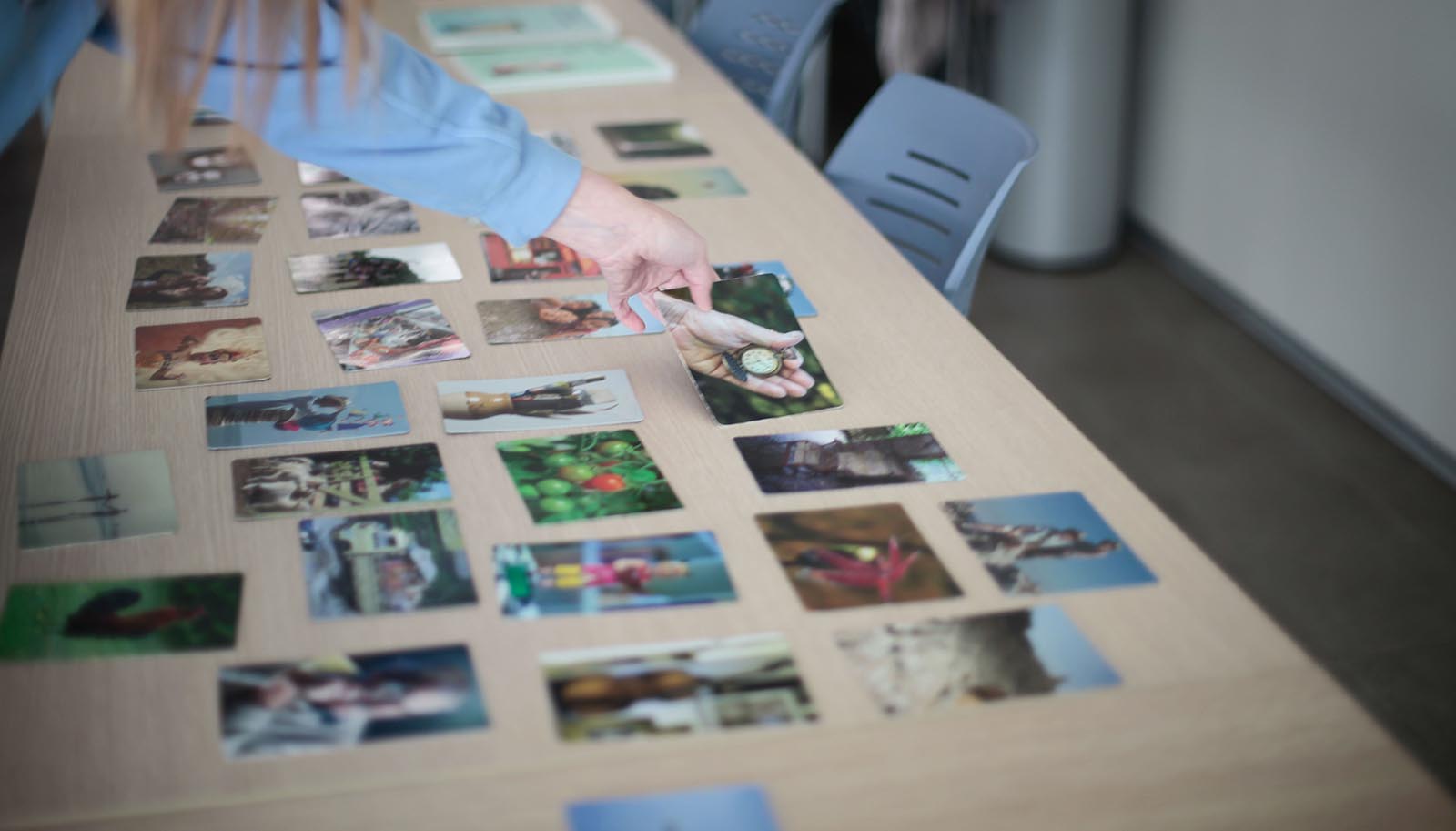
From this perspective, at ANDANAfoto we understand photography as a starting point. Through photography, we accompany processes of self-knowledge in which what appears in the image is not accidental: it speaks about us, our emotions, and our history.
This connects directly with bio-informational theory: images are not just something we see, but something that activates internal networks where memories, bodily sensations, emotions, and personal meanings intertwine. It is not only about taking photographs, but about using them as a tool to review, understand, and reframe what we experience and who we are. Because when an image touches us, when that punctum appears, it is not just about aesthetics: it is the activation of something deeper. It is a doorway. And crossing it can transform the way we see ourselves… and the way we inhabit the world.
References
Lang, P. J. (1977). Imagery in therapy: An information processing analysis of fear. Behavior Therapy, 8(5), 862–886. https://doi.org/10.1016/S0005-7894(77)80157-3
Hoppe, J. M. (2021). Emotional mental imagery and the reduction of fear within the mind’s eye (Doctoral dissertation, Uppsala University). Acta Universitatis Upsaliensis. https://urn.kb.se/resolve?urn=urn:nbn:se:uu:diva-440388
Cómo citar este artículo
Al citar, reconoces el trabajo original, evitas problemas de plagio y permites acceder a las fuentes originales para obtener más información o verificar datos. Asegúrate siempre de dar crédito y de citar de forma adecuada.
How to cite this article
By citing an article, you acknowledge the original work, avoid plagiarism issues, and allow access to the original sources for further information or data verification. Make sure to always give credit and cite appropriately.
If you’d like to learn more about photography and personal development, I invite you to explore:
Learn to slow down, connect with the present moment, and train your visual perception without judgment or expectations.